

Key Takeaways
- Fatty liver disease is one of the most common liver conditions in the United States, affecting an estimated 24% of adults.
- Most people have no symptoms, so the condition is often found incidentally during imaging or blood tests ordered for another reason.
- A minority of cases progress to more serious stages involving liver inflammation and scarring.
- Lifestyle changes, particularly around diet and physical activity, are the main tool doctors use to manage early-stage disease.
- A healthcare provider should evaluate any liver-related findings before conclusions are drawn about diagnosis or treatment.
Fatty liver disease
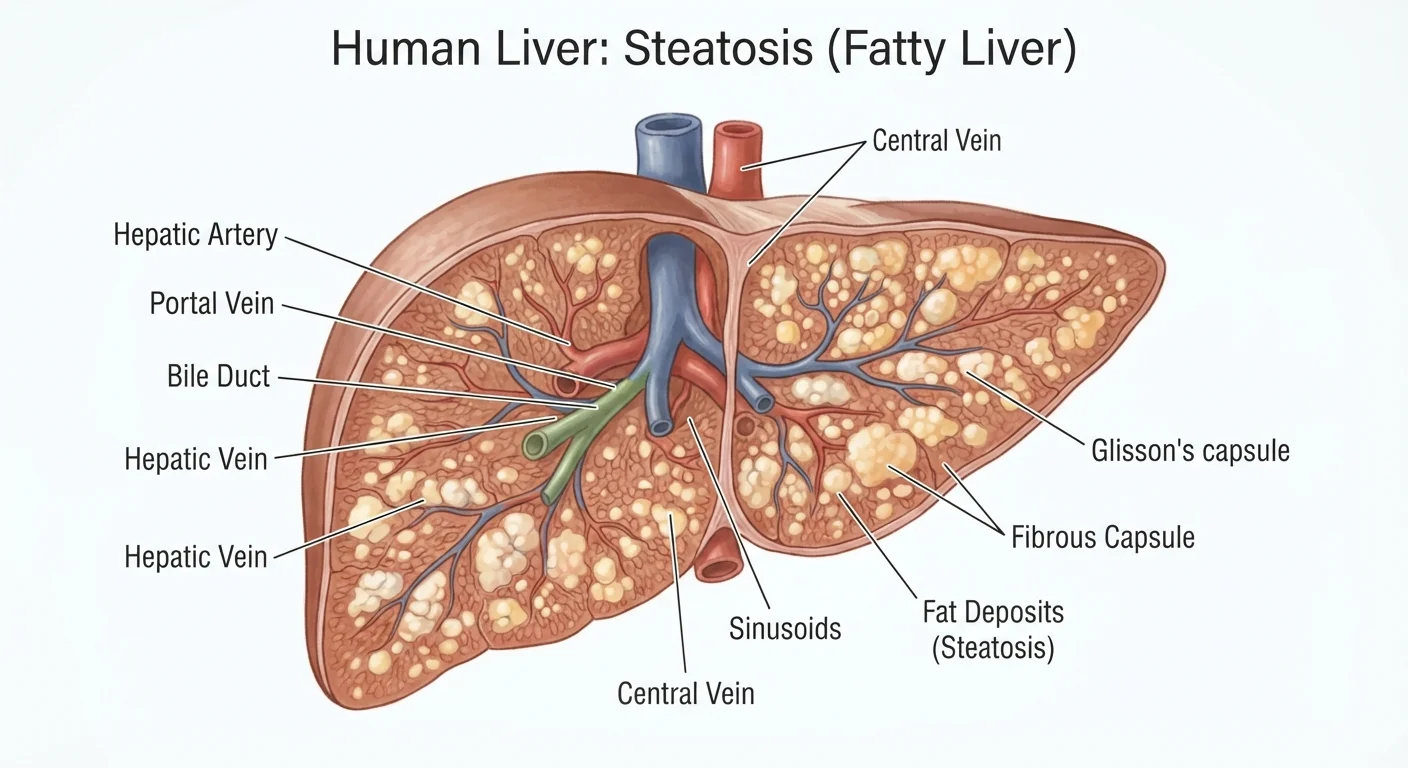
Fatty liver disease is a condition in which fat builds up inside liver cells beyond what the organ can manage. The most common form is metabolic dysfunction-associated steatotic liver disease (MASLD), previously called non-alcoholic fatty liver disease (NAFLD). In many people, the condition causes no symptoms and does not progress. In others, the fat triggers inflammation that can gradually damage liver tissue over years.
MASLD is diagnosed when hepatic steatosis (fat in more than 5% of liver cells) is present alongside at least one metabolic risk factor, such as excess body weight, elevated blood glucose, or high blood pressure.
How fat accumulates in the liver
The liver processes fats that arrive from the digestive system and from fat stores elsewhere in the body. When more fat arrives than the liver can process and export, some of it stays inside liver cells. A small amount of stored fat is normal. The problem begins when fat makes up more than roughly 5% of the liver's total cell volume.
This buildup most often develops alongside metabolic conditions: excess body weight (particularly around the abdomen), insulin resistance, elevated triglycerides, and high blood pressure. Type 2 diabetes is both a risk factor and a frequent companion condition. The liver, in these circumstances, is handling more fat and glucose than usual while also managing a hormonal environment that makes efficient processing harder.
Alcohol causes a distinct but superficially similar condition. Doctors distinguish the two based on reported alcohol consumption, medical history, and test results, because management differs.
The stages of fatty liver disease
Fatty liver disease is not one fixed state. It sits on a spectrum, and where a person falls on that spectrum shapes how seriously doctors treat it.
Simple steatosis is the earliest and most common stage. Fat is present in liver cells, but there is no significant inflammation or cell damage. Most people remain at this stage indefinitely, and the liver continues to function normally.
Metabolic dysfunction-associated steatohepatitis (MASH), previously known as non-alcoholic steatohepatitis (NASH), is the more serious form. Here, fat accumulation has triggered inflammation inside the liver. Over time, that inflammation can damage liver cells and prompt the production of scar tissue.
Fibrosis refers to the accumulation of that scar tissue. Mild fibrosis does not stop the liver from working, but advanced fibrosis (cirrhosis) reduces liver function significantly and raises the risk of liver failure and liver cancer.
The progression from simple steatosis to cirrhosis is possible but far from inevitable. Research suggests that only a minority of people with simple steatosis develop MASH, and a smaller fraction of those go on to develop cirrhosis.
~24%
U.S. adults estimated to have MASLD
Based on epidemiological estimates published in liver disease literature, roughly one in four U.S. adults has some degree of hepatic steatosis.
~20%
Of MASLD cases that progress to MASH
Clinical research suggests approximately one in five people with simple steatosis develops the inflammatory form, MASH, though individual risk varies.
5-10%
Body weight loss associated with liver improvement
Clinical guidelines note that a sustained reduction of 5 to 10% of body weight is associated with measurable improvement in liver fat and inflammation markers in many patients.
What the diagnosis means in practice
Many people learn they have fatty liver disease from a routine blood test or an ultrasound ordered for an unrelated complaint. An imaging report noting a "fatty" or "echogenic" liver, or blood results showing elevated alanine aminotransferase (ALT) or aspartate aminotransferase (AST), can be the first and only sign.
Neither result alone tells the full story. Elevated liver enzymes can have multiple causes. Imaging can detect fat but cannot determine whether inflammation or fibrosis is present. A physician evaluates those results alongside the patient's full medical history, weight, metabolic markers, and sometimes further testing before characterizing the severity.
For most people diagnosed at the simple steatosis stage, the immediate clinical focus is on the metabolic conditions that drove the fat accumulation. Improving blood glucose control, reducing body weight if indicated, and adjusting dietary patterns are the approaches with the most consistent evidence behind them. No medication is currently approved in the U.S. specifically to reverse early-stage MASLD, though research in this area is active.
MASH with significant fibrosis requires closer monitoring because the risk of progression is higher. In those cases, a hepatologist (a specialist in liver disease) often takes over or co-manages care.
This article is for general informational purposes only and does not constitute medical advice. Consult a qualified healthcare provider for evaluation, diagnosis, or guidance specific to your health situation.