

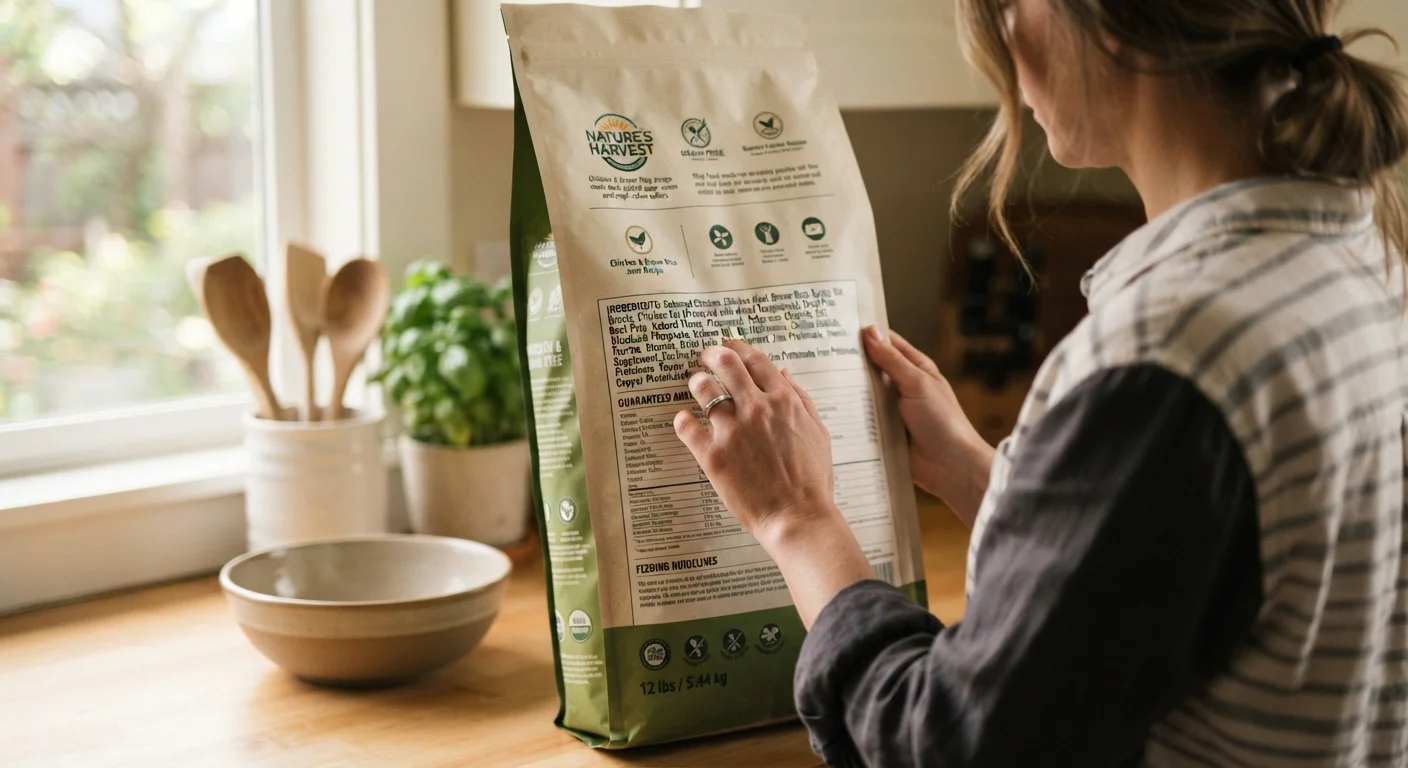
Key Takeaways
- Ingredients are listed by weight before processing, so moisture content affects their position on the list.
- The guaranteed analysis shows minimum or maximum nutrient percentages, not exact amounts.
- An AAFCO nutritional adequacy statement tells you whether a food is complete and balanced for a specific life stage.
- "By-product" is a defined regulatory term, not shorthand for poor quality.
- Life stage matters: food labeled for "all life stages" must meet the most demanding nutrient profile, which covers growth and reproduction.
Pet food label
A pet food label is the regulated packaging text that tells you what a product contains, what nutrients it provides, and whether it meets recognized standards for animal nutrition. In the United States, labels must follow rules set by the Association of American Feed Control Officials (AAFCO) and state feed laws. Reading a label correctly lets you compare products on facts rather than marketing images.
AAFCO does not directly approve or certify pet foods; it publishes model regulations and nutrient profiles that manufacturers reference when making nutritional adequacy claims.
The five parts of every pet food label
Every commercial pet food sold in the United States must display five regulated pieces of information: the product name, the net weight, the manufacturer's name and address, the ingredient list, and the guaranteed analysis. A sixth element, the nutritional adequacy statement, is required for any food claiming to be complete and balanced. Together, these six items give you the factual picture behind the front-of-bag photography and flavor descriptors.
The product name itself is regulated. If a single ingredient appears in the name, such as "Salmon Cat Food," that ingredient must make up at least 95 percent of the total product weight, excluding water. If the name says "with salmon," the threshold drops to just 3 percent. The word "dinner," "platter," or "formula" signals a 25 percent threshold. This naming ladder is worth knowing because it changes what you can infer before you even flip the bag over.
State regulations also apply
AAFCO publishes model regulations, but enforcement happens at the state level. Most states adopt AAFCO guidelines, though requirements can vary. If you see a label that seems inconsistent or unclear, your state department of agriculture is the relevant authority to contact.
Reading the ingredient list accurately
Ingredients appear in descending order by weight before processing. Water weight counts, which is why fresh or frozen chicken often appears before rice or corn even when the finished kibble contains more grain by dry weight. This is called "ingredient splitting" in reverse: understanding it prevents you from over-reading the first ingredient as a guarantee of the product's protein concentration.
"Meal" ingredients, such as chicken meal or salmon meal, have already had moisture removed. They are concentrated sources of protein and often outweigh fresh meat on a dry-matter basis even when listed further down. A food with chicken meal as its second ingredient may deliver more protein per cup than one with fresh chicken listed first.
By-products are a defined category under AAFCO, covering clean parts of slaughtered animals other than skeletal muscle, including liver, kidney, and lung. These are common ingredients in diets across the world and can be nutritionally appropriate. The word does not indicate low quality on its own. What matters more is whether the food as a whole meets the nutritional adequacy standard for your pet's life stage. For a broader look at what pet care actually costs, see the full financial picture of pet ownership.
The guaranteed analysis and what it does not tell you
The guaranteed analysis lists four values: minimum crude protein, minimum crude fat, maximum crude fiber, and maximum crude moisture. These are regulatory boundaries, not the actual nutrient content of any specific batch. A food guaranteeing a minimum of 26 percent crude protein could contain 26 percent or 32 percent in practice.
Comparing a wet food to a dry food using these numbers is misleading without a dry-matter conversion. Wet food may show 8 percent protein while dry food shows 28 percent, but the wet food might actually deliver similar protein once water is removed from the equation. Divide the nutrient percentage by the percentage of dry matter (100 minus the moisture percentage) to get a true comparison figure.
How to do a dry-matter conversion
Find the moisture percentage on the guaranteed analysis. Subtract it from 100 to get the dry-matter percentage. Then divide the nutrient value (say, crude protein) by that dry-matter percentage and multiply by 100. This gives you a number you can compare across wet and dry foods on equal footing.
AAFCO nutritional adequacy statements
This statement is the single most useful line on the label. It tells you whether the food is complete and balanced for a life stage, and how that conclusion was reached. There are two methods: formulation (the recipe meets AAFCO nutrient profiles on paper) and feeding trials (animals actually ate the food and maintained health over a defined period). Feeding trial claims are generally considered stronger evidence, though both are acceptable under current regulations.
Life stage options include growth, adult maintenance, reproduction, and all life stages. "All life stages" must satisfy AAFCO's most demanding nutrient profile, which covers growing puppies and kittens as well as pregnant or nursing animals. This is not a flaw, but it does mean an all-life-stages food may contain more calcium or calories than a low-activity adult needs. Your veterinarian can help match life stage designation to your individual pet, particularly as nutritional needs shift over time. The article how aging changes what your pet needs covers those shifts in detail.
This article is for general informational purposes only and is not veterinary advice. Consult a licensed veterinarian for guidance on your specific pet's nutritional needs.