

Key Takeaways
- A migraine is a neurological event driven by changes in brain activity and nerve signaling, not simply a severe headache.
- A spreading wave of electrical suppression called cortical spreading depression is central to how migraines develop.
- The trigeminal nerve system carries pain signals that produce the throbbing head pain most people associate with migraines.
- Aura symptoms such as visual disturbances arise from that wave of altered brain activity, not from eye problems.
- Triggers vary widely by person; no single cause explains why a migraine starts.
- Anyone experiencing new, severe, or unusual headache symptoms should speak with a healthcare professional.
Migraine
A migraine is a neurological condition in which a wave of abnormal brain activity triggers a cascade of changes in blood flow, nerve signaling, and brain chemistry. The result is often intense head pain, but also nausea, light sensitivity, and other symptoms. Attacks can last anywhere from a few hours to several days.
Migraines are classified by the International Headache Society into subtypes including migraine without aura, migraine with aura, and chronic migraine, based on frequency and accompanying neurological symptoms.
The four phases of a migraine attack
Most migraines move through up to four phases, though not every person experiences all of them. Understanding each phase helps explain why symptoms can start well before head pain appears and linger long after it fades.
Prodrome can begin hours or even days before pain. The hypothalamus, a brain region involved in regulating sleep, appetite, and mood, shows altered activity during this phase. People may notice yawning, food cravings, neck stiffness, or mood changes. These are not random; they reflect early disruption in brain signaling.
Aura affects roughly one in three people with migraines. It produces temporary neurological symptoms, most often visual, that develop gradually over five to twenty minutes. The mechanism is cortical spreading depression, described in the next section.
Headache is the phase most people recognize. Throbbing pain, usually on one side, accompanies sensitivity to light, sound, and sometimes smell. Movement worsens it. This phase can last four to seventy-two hours.
Postdrome follows as pain fades. The brain does not simply return to baseline immediately. Fatigue, difficulty concentrating, and lingering light sensitivity are common for up to a day afterward.
Cortical spreading depression: the wave behind aura
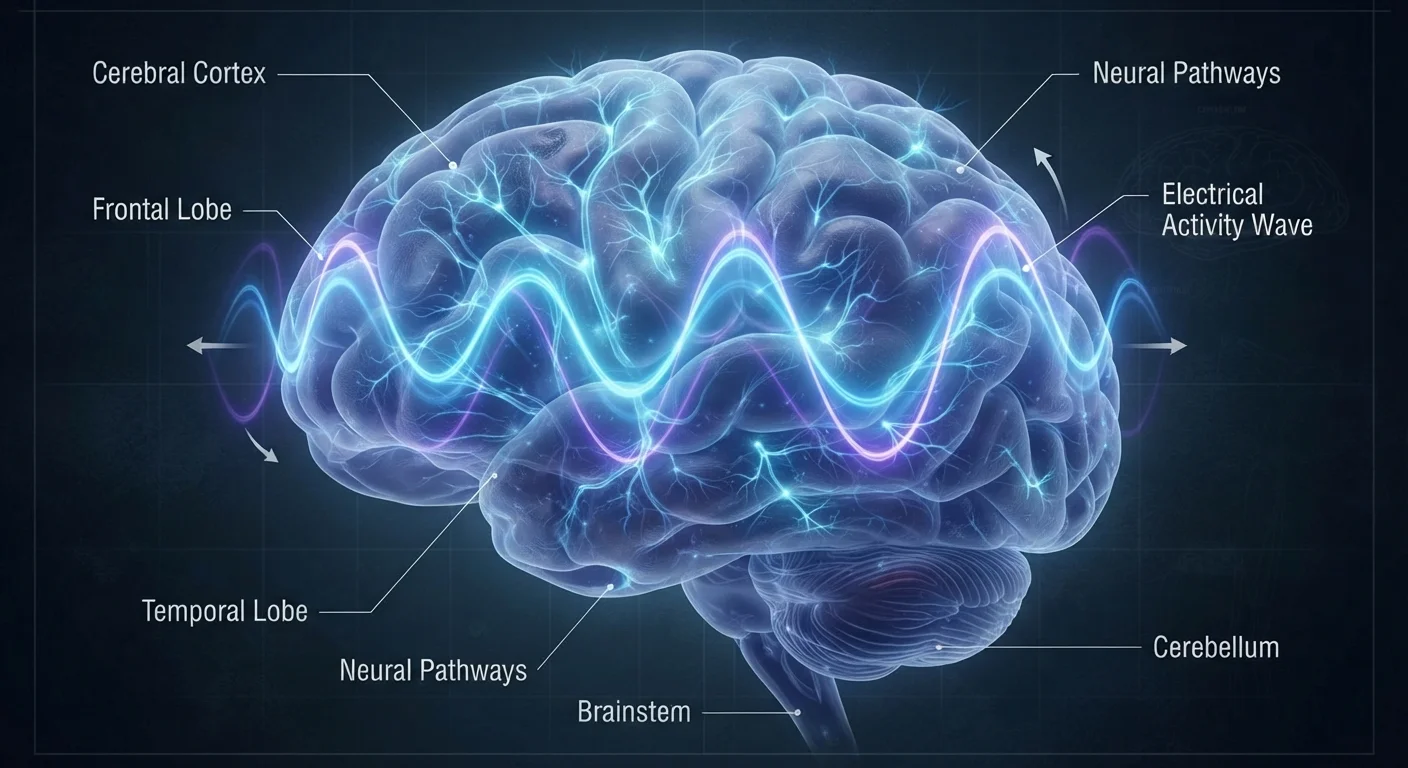
Aura begins with a phenomenon called cortical spreading depression (CSD). This is a slow-moving wave of intense neuronal firing followed by a prolonged period of suppressed activity. It travels across the brain's outer layer (the cortex) at roughly three to five millimeters per minute.
As CSD passes through the visual cortex at the back of the brain, it temporarily disrupts how visual signals are processed. This is why aura most often appears as visual disturbances: a shimmering arc, a blind spot, or geometric patterns. If the wave moves into areas that handle sensation or language, a person may feel numbness or have brief word-finding difficulty.
CSD also appears to activate the trigeminal nerve system, which carries pain signals from the head and face to the brain. This activation is what sets the headache phase in motion.
Aura without knowing it
Some people experience very subtle aura that they do not recognize as a neurological symptom. Mild visual static, brief numbness in a fingertip, or a fleeting difficulty finding a word can all be aura manifestations. If you notice these patterns before headaches, mention them to a healthcare professional, as the distinction between migraine with and without aura can affect management options.
How the trigeminal system produces migraine pain
The trigeminal nerve is the main sensory nerve of the face and head. During a migraine, its branches that wrap around blood vessels in the meninges (the membranes covering the brain) become activated. These nerve fibers release inflammatory molecules, causing the surrounding blood vessels to dilate and become more sensitive.
Pain signals travel from those sensitized vessels along the trigeminal nerve to the brainstem, then up to the thalamus and cortex, where pain is consciously perceived. The throbbing quality of migraine pain corresponds to the pulse of blood through those dilated, inflamed vessels.
Over the course of an attack, a process called central sensitization can develop. The pain-processing pathways themselves become heightened. This is why, by mid-attack, even gentle touch to the scalp or moving the eyes can feel painful. It also explains why treating a migraine early, before sensitization sets in, is generally more effective.
Why symptoms vary so widely between people
No two people experience migraines identically, and the same person can have attacks that differ in severity or character. Several factors contribute to this variation.
Genetics influence which areas of the brain are most susceptible. Brain chemistry, particularly levels of serotonin and calcitonin gene-related peptide (CGRP), a molecule heavily involved in migraine pain transmission, differs between individuals and fluctuates over time.
Hormonal changes affect migraine frequency in many people. Estrogen fluctuations around menstruation are one of the most consistent triggers identified in clinical research. This partly explains why migraines are more common in women of reproductive age.
External triggers such as disrupted sleep, certain foods, stress, and changes in barometric pressure can lower the threshold for an attack in susceptible individuals. However, triggers do not cause migraines on their own; they interact with an underlying neurological vulnerability.
This article is for informational purposes only and is not a substitute for professional medical advice, diagnosis, or treatment. If you have concerns about migraines or headache symptoms, speak with a qualified healthcare provider.