

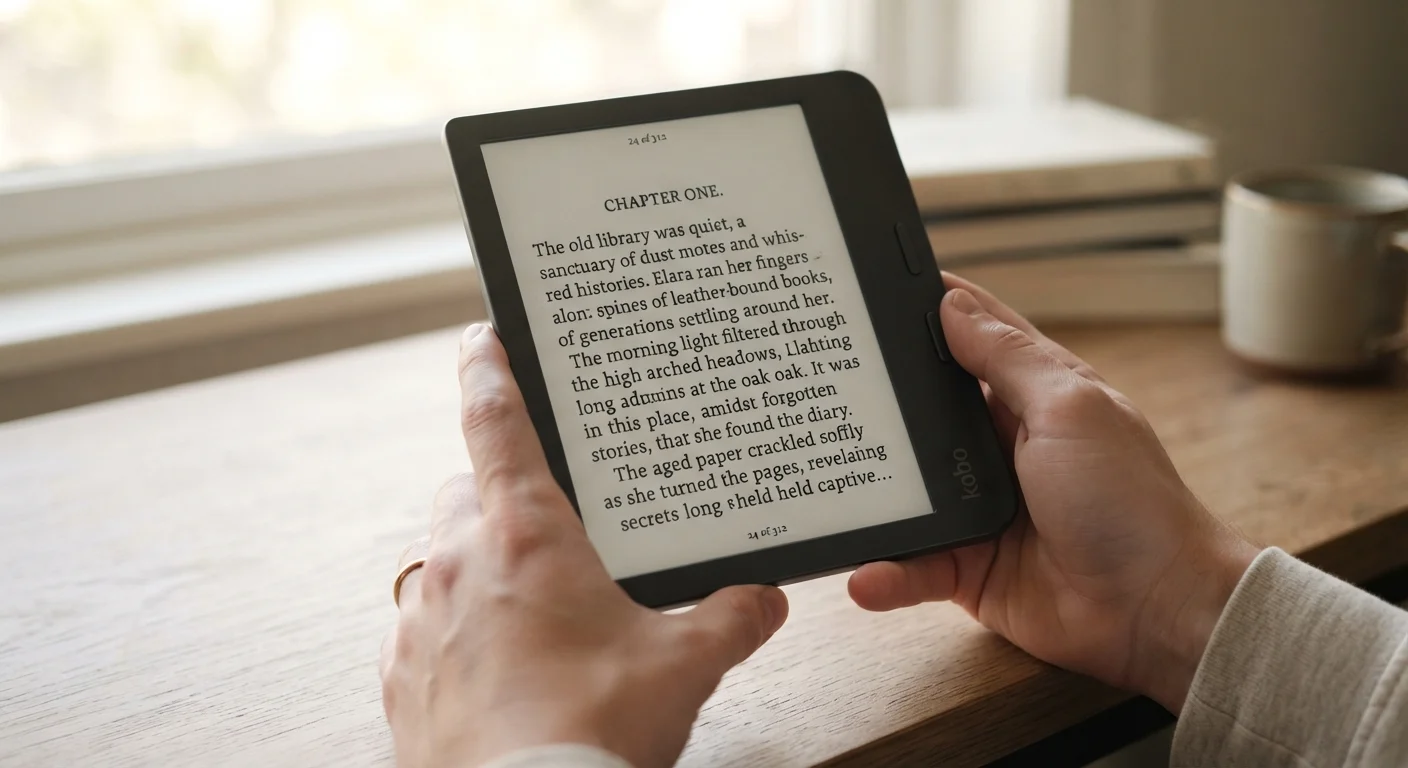
Key Takeaways
- E-ink displays work by moving charged particles inside tiny capsules, not by projecting light at your eyes.
- Because e-ink reflects light rather than emitting it, reading in bright sunlight is comfortable rather than washed out.
- E-ink screens only use power when the image changes, which is why e-reader batteries last weeks instead of hours.
- The slow refresh rate of e-ink makes it poor for video but well-suited to static text.
- Front-lit e-readers add a separate LED layer to allow reading in the dark without the screen itself generating light.
Electronic ink (e-ink)
Electronic ink is a display technology that uses tiny capsules filled with charged particles to form text and images. Unlike a phone or laptop screen, it does not produce its own light. Instead, it reflects ambient light, the same way a printed page does. This is what gives e-readers their paper-like appearance.
The technology is formally called electrophoretic display (EPD). Electrophoresis describes the movement of charged particles through a fluid under an electric field, which is exactly what happens inside each microcapsule.
What is actually inside an e-ink screen
An e-ink panel is made of millions of microcapsules, each about the diameter of a human hair. Inside each capsule floats a clear fluid containing two types of tiny particles: white ones with a positive charge and black ones with a negative charge.
Electrodes beneath the capsules apply a small electric voltage. When the bottom electrode goes positive, the negatively charged black particles are pulled down and the white particles rise to the surface, making that spot look white. Reverse the voltage and the black particles come to the top, creating a dark spot. Arrange enough capsules in the right pattern and you get legible text.
The crucial detail: once the particles settle, the image stays put with no power at all. The capsules hold their position like iron filings locked under a magnet. Power is only needed to change the image, which is why turning a page on an e-reader costs almost no energy.
Ghosting is normal, not a defect
If you notice a faint shadow of a previous page behind new text, that is ghosting: some particles did not fully migrate during a partial refresh. A full refresh cycle (the brief black flash) clears it. Most devices trigger a full refresh automatically every few page turns.
Why it looks like paper and not a screen
Most screens you use daily are emissive: they generate light and shoot it at your eyes. LCD panels use a backlight, and OLED panels light up individual pixels. E-ink is reflective. It bounces room light back toward you, exactly as a printed page does.
Your visual system processes reflected light differently from emitted light. With a conventional screen, your pupils are responding to a light source. With e-ink, they respond to reflected ambient light. In bright sunlight, a phone screen gets harder to read because the emitted light is overwhelmed. An e-ink screen gets easier to read because there is more ambient light to reflect.
Contrast ratio on e-ink is also very stable across viewing angles. You can tilt the device and the text does not wash out or shift color, again because the physics match printed ink on paper rather than a lit panel behind glass.
This is also why spec sheets leave out details that shape daily use: a high PPI number on an e-reader tells you about sharpness, but it says nothing about reflectivity, glare coating, or how the display behaves under different lighting conditions.
The trade-offs that come with the technology
E-ink has two practical limitations worth understanding before you use a device built around it.
The first is refresh speed. Moving charged particles through fluid takes time, roughly 120 to 300 milliseconds per full-page refresh on current devices. That is fast enough for turning book pages, but it rules out smooth scrolling, video playback, or any interface that needs to update continuously. Animations and fast-moving graphics look choppy or produce ghosting artifacts.
The second is color. Standard e-ink uses only black and white particles. Color versions add complexity: one approach uses a color filter array over the black-and-white layer, similar to how color film photography worked. Color e-ink panels achieve this but at the cost of lower contrast and slower refresh times compared to monochrome panels.
These trade-offs are not flaws so much as properties of the physics involved. An e-reader is purpose-built for long-form text reading, and e-ink matches that purpose well. For everything else, you would reach for a different kind of screen. The same pattern of purpose-built hardware comes up in how smartwatch sensors are designed for specific measurements rather than general-purpose data collection.
Front lights, warm tones, and reading in the dark
A base e-ink screen is completely dark in a dark room. To read at night, manufacturers add a front-light layer: a thin sheet of light guides that sit on top of the e-ink panel and direct LED light across the screen surface rather than through it from behind.
This is different from a backlit display. The light grazes the surface, which preserves the paper-like quality while making the text visible in low ambient light. You can dim the front light significantly, far lower than most phone screens allow.
Many current e-readers include adjustable color temperature in the front light, letting you shift from cool white to warm amber. Warm light contains less blue-spectrum light, and there is ongoing research into whether blue light from screens affects sleep quality. However, individual responses vary, and anyone with specific concerns about sleep or eye health should speak with a medical professional rather than relying on a device setting alone.