

Key Takeaways
- Smart speakers do far more than stream music: they handle timers, reminders, questions, and smart home control.
- The voice assistant inside the speaker does the actual work; the speaker hardware is just the interface.
- Your voice requests are processed on remote servers, which has real privacy implications worth understanding.
- Smart home control only works if your other devices are compatible with the same ecosystem.
- Setup choices made at installation affect your privacy and security long-term.
Smart speaker
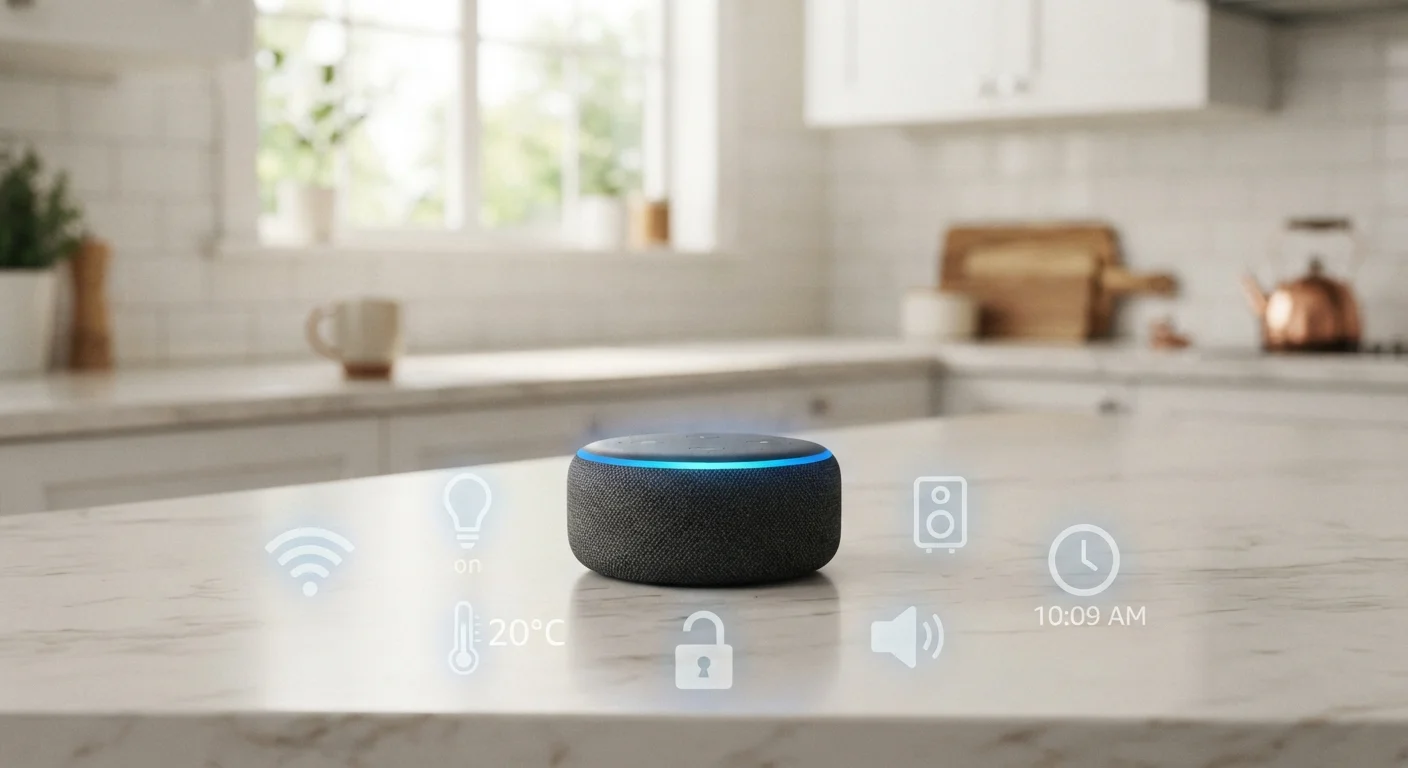
A smart speaker is a wireless audio device with a built-in voice assistant that can respond to spoken commands. Beyond playing audio, it connects to the internet and to other smart devices in your home, letting you ask questions, set reminders, control lights, and more, all hands-free. It listens for a specific wake word before it starts processing your request.
Smart speakers use a combination of always-on local microphone detection for the wake word and cloud-based natural language processing to interpret full commands. The audio of your request is sent to remote servers for interpretation.
The voice assistant is the real product
The speaker cabinet and audio hardware are just the delivery mechanism. The functional core of any smart speaker is the voice assistant running inside it. That assistant, whether it is Alexa, Google Assistant, or Siri, is a cloud-connected software system that interprets spoken language, queries information, and sends instructions to other services and devices.
When you speak a command, the device captures the audio, sends it to remote servers for processing, and receives a response, all within a second or two. The speed makes it feel local, but the intelligence lives in the cloud. This matters because it means the device's capabilities can expand over time through software updates without any change to the physical hardware you own.
For a broader look at how connected devices handle sensing and processing, the breakdown of smartwatch sensors covers similar concepts in a wearable context.
What smart speakers actually do
Music and podcasts get most of the attention in marketing, but they represent a small fraction of what the device can handle. Here is a more complete picture of functional categories:
- Information retrieval: weather, unit conversions, dictionary definitions, sports scores, general knowledge questions answered verbally in real time.
- Reminders and timers: multiple simultaneous timers, named reminders, and calendar entries that sync to connected accounts.
- Smart home control: adjusting lights, thermostats, locks, and plugs by voice, provided those devices are compatible with the same ecosystem.
- Shopping and lists: adding items to a shared grocery list, reordering household goods through a linked account.
- Communication: placing calls, sending messages, and making announcements to other speakers in the same home.
- Routines: a single command that triggers a sequence of actions, such as dimming lights, reading the weather, and starting a playlist at bedtime.
Check ecosystem compatibility first
Before buying any smart home device you plan to control by voice, look at the compatibility list for your specific speaker platform. Devices that work with one assistant do not automatically work with another. A few minutes of checking up front prevents a return trip to the store.
Smart home control is where compatibility becomes a practical constraint. A speaker tied to one ecosystem will not natively control devices built for a competing one. Before buying smart bulbs or plugs to control by voice, confirm they share the same ecosystem as your speaker.
Where smart speakers fall short
The technology has genuine limitations that affect day-to-day usefulness. Voice recognition accuracy drops in noisy rooms, with heavy accents, or when multiple people speak at once. Commands that are ambiguous or multi-step often produce wrong results or require rephrasing.
The assistant cannot browse the open web on your behalf, fill out forms, or take actions inside apps. It handles a defined set of supported skills and integrations; anything outside that set gets a polite refusal. Complex tasks that involve judgment, such as comparing prices across sites or summarizing a long document, are beyond what current consumer smart speakers reliably do.
Privacy is a structural concern, not just a theoretical one. Accidental wake-word triggers are common, and when they happen, a few seconds of audio are transmitted and sometimes stored. Most platforms offer settings to review and delete voice history, and physical mute buttons disable the microphone entirely when needed. Setup steps that most people skip covers the privacy and security settings worth configuring before you start using any smart home device.
How it fits with other connected devices
A smart speaker works best as a control point in a connected home rather than a standalone gadget. On its own, it handles information and audio tasks. Paired with compatible smart home hardware, it becomes a voice interface for your environment.
35%
US adults who own a smart speaker
According to Pew Research Center survey data from 2023, roughly 35% of American adults reported owning a smart speaker.
Top 3
Most common voice tasks
Pew Research Center found that playing music, checking weather, and setting timers or reminders were the most frequently reported uses among smart speaker owners.
Routines are the most underused feature for people who have had a smart speaker for a while. Rather than issuing individual commands, a routine lets one phrase trigger several actions in sequence, which is useful for consistent morning or evening patterns.
For tasks that go beyond voice and involve automating digital workflows on a phone or computer, automation apps handle a different but complementary layer of everyday efficiency.