

Key Takeaways
- End-to-end encryption means only the sender and recipient can read a message, not the app company.
- E2EE protects message content in transit but does not protect metadata such as who you message or when.
- Screenshots, device access, and backups can all expose messages that were encrypted in transit.
- Not all messaging apps use E2EE by default; some require you to enable it manually.
- Encryption strength matters less for most people than understanding what their app does and does not protect.
End-to-end encryption
End-to-end encryption (E2EE) is a method of scrambling messages so that only the sender and the intended recipient can read them. The message is encoded on the sender's device and only decoded on the recipient's device. No one in between, including the app company, internet providers, or anyone intercepting the data in transit, can read the content.
E2EE relies on cryptographic key pairs: each user holds a private key that never leaves their device, and a corresponding public key is used to encrypt messages addressed to them. Without the private key, the ciphertext is computationally infeasible to reverse.
How the scrambling actually works
When you send a message through an app with E2EE, your device converts the text into ciphertext before it leaves your phone. That ciphertext travels through the app's servers and your recipient's internet connection. When it arrives, only your recipient's device holds the key to convert it back into readable text.
Think of it like a lockbox. You put a note inside, snap a lock that only the recipient's key can open, and ship the box. The courier handles it, the warehouse stores it temporarily, but neither can read the note. The app company is the courier and the warehouse: it moves and briefly holds the box, but the lock is beyond its reach.
This is different from the encryption most websites use. When you visit a site over HTTPS, the connection between your browser and the site's server is encrypted. But the server itself decrypts your data to process it. E2EE takes the server out of that final decryption step entirely.
E2EE applies to content, not identity
End-to-end encryption protects what you say, not the fact that you said it. Metadata such as your phone number, your contact list, message timestamps, and rough location data may still be collected and stored by the app, even when content is fully encrypted. Privacy and encryption are related but not the same thing.
What end-to-end encryption does not protect
E2EE secures message content while it moves across a network. Several things fall outside that protection.
- Metadata: The app may still log who you contacted, when, how often, and from which location. Message content is hidden; the pattern of communication often is not.
- Your device itself: If someone unlocks your phone, they can read your messages directly on screen. Encryption in transit offers nothing against physical access to an unlocked device.
- The other person's device: A message decrypted on the recipient's phone is now sitting in plain text. If their device is compromised or someone takes a screenshot, the content is exposed regardless of how well it was encrypted in transit.
- Cloud backups: Many messaging apps offer optional or automatic backup to cloud storage. Those backups may not be end-to-end encrypted. If your chat history syncs to a cloud account without E2EE, the cloud provider can access it.
For a broader look at how apps handle data beyond messaging, the trade-offs of granting apps access to your inbox covers how permission structures work across different types of tools.
Default settings vary widely by app
Some messaging apps encrypt every conversation by default and have done so for years. Others treat E2EE as an optional feature that users must activate for individual chats. A few apps encrypt messages between their own users but drop that protection when sending to standard SMS.
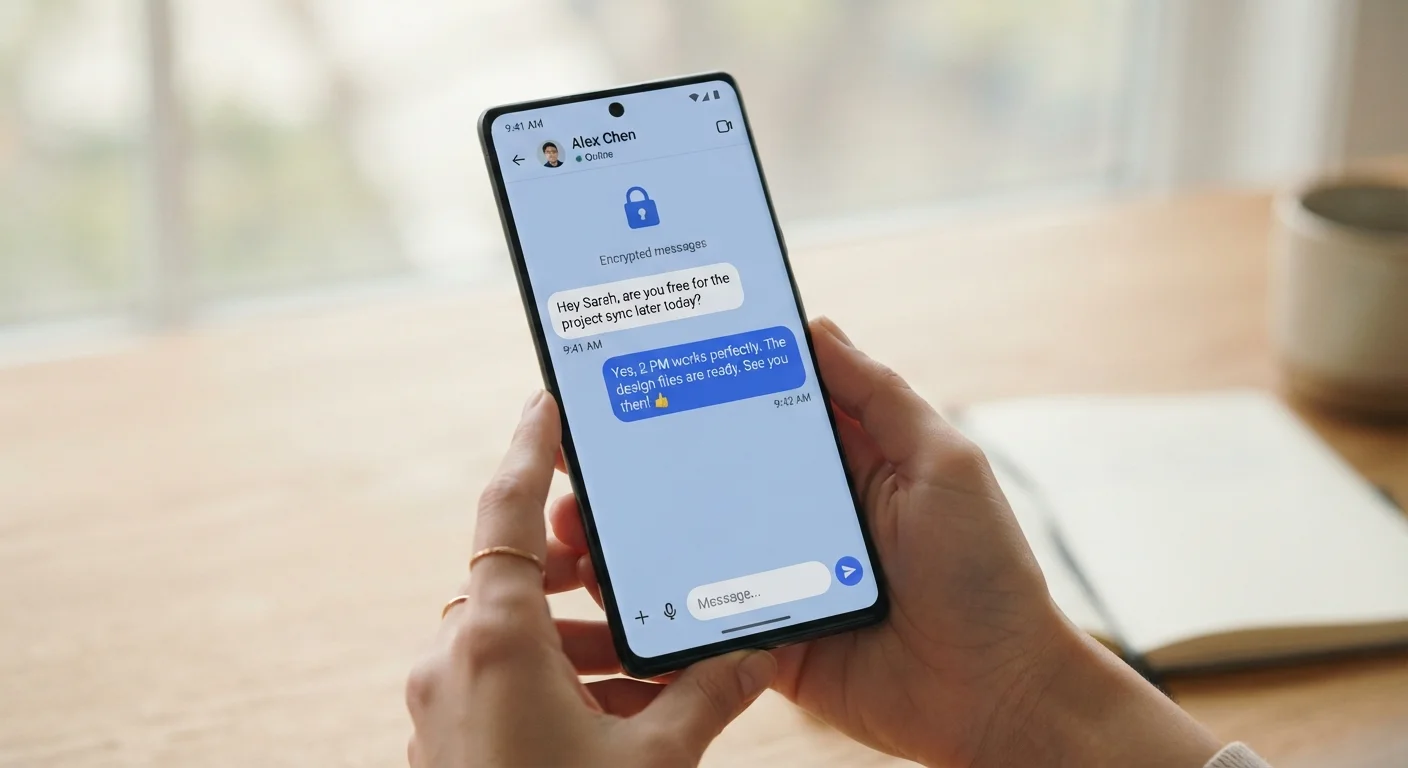
The practical consequence is that assuming your messages are encrypted without checking is a reasonable mistake to make, and it is worth taking two minutes to verify. Look for a lock icon or a note in the chat header, or check the app's privacy documentation directly.
Video conversations carry similar variation in how privacy protections are applied. The plain-language comparison of how video calling apps handle privacy breaks down where the differences sit across popular platforms.
Why the concept matters in practice
For most everyday conversations, E2EE means a company whose app you use cannot read your private messages, even if compelled by a legal request, because the data it holds is unintelligible without keys it does not possess. That is a meaningful shift from older messaging systems where the service provider held decrypted copies of everything.
It also means the risk of a company data breach exposing your message content is significantly lower. A server breach exposes ciphertext, which is useless without the private keys stored on individual devices.
The practical question is less about whether encryption exists and more about the full picture: what the app encrypts, what it logs, how backups work, and who controls access to your device. Those variables together determine how private a conversation actually is.