

Key Takeaways
- Informal transit options like minibuses and shared taxis often run where official routes do not.
- Learning a few local transit terms before arrival makes boarding far less stressful.
- Fares on informal networks are usually paid in cash, so small local currency is worth carrying.
- Neighborhood ferries and water taxis exist in many port cities and are rarely listed in tourist guides.
- Watching how locals board, pay, and signal stops is the most reliable real-time instruction available.
- Verify current safety and entry conditions with official sources before relying on any transit option.
What tourist maps leave out
Official transit maps show what city governments want visitors to use. They rarely show what residents actually rely on. In dozens of cities across Latin America, West Africa, Southeast Asia, and the Middle East, the bulk of daily movement happens on vehicles that appear in no app and no guidebook: shared minibuses running fixed corridors, collective taxis that follow set routes for a flat fare, motorcycle taxis for short hops, and ferry crossings that connect neighborhoods divided by water.
None of this is hidden, exactly. The infrastructure is visible on every busy street. But without context, it reads as chaos. With a little preparation, it becomes a faster, cheaper, and more direct way to move through a city than any tourist shuttle. This list covers the most common informal transit types, how they work, and what to watch for before you board.
For broader context on getting around unfamiliar cities, reading a foreign transit map is a good companion piece.
Safety and conditions vary widely
Informal transit is routine and safe for millions of daily riders in many cities. That said, conditions, reliability, and risk levels differ significantly by destination, time of day, and route. Before using any unfamiliar transit system, check your government's current travel advisory for the destination and ask locally about which options residents consider reliable. General information in any article cannot substitute for on-the-ground knowledge.
Six informal transit types worth knowing
Minibuses and route vans
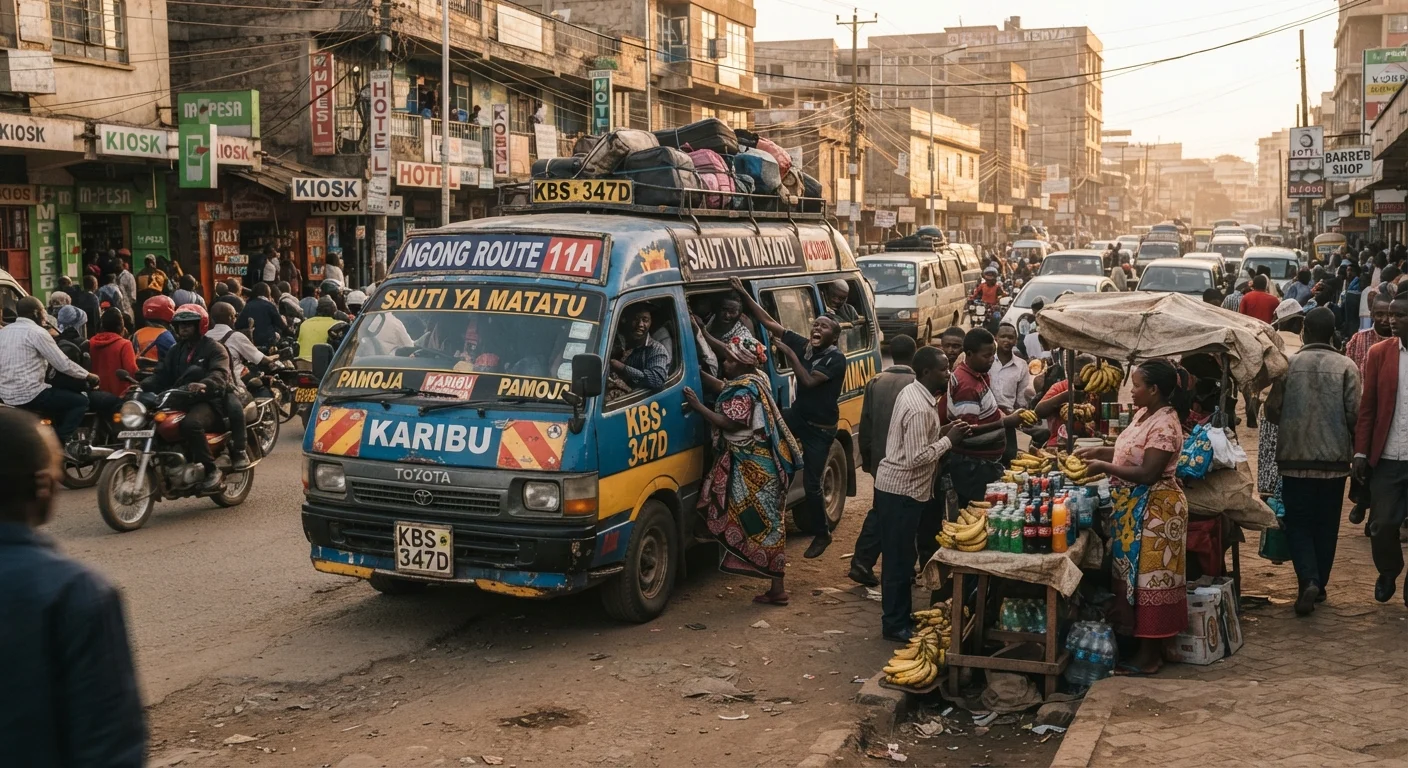
Known as matatus in East Africa, marshrutkas in the former Soviet states, jeepneys in the Philippines, and by dozens of other names elsewhere, fixed-route minibuses are the backbone of urban transit in much of the world. They follow set corridors, stop on demand rather than at fixed signs, and charge a flat or distance-based cash fare.
Boarding works by flagging the vehicle down at the roadside. The fare collector, often a separate person from the driver, will tell you the cost. To signal your stop, either call out or knock on the ceiling or window, depending on local convention. Watching other passengers for the first few rides tells you which method applies.
Fixed-route minibuses are the backbone of urban transit in much of the world.
Collective taxis
A collective taxi (called colectivo, taxi brousse, grand taxi, or similar depending on the country) fills seats before departing, then follows a fixed route. The per-person fare is a fraction of a private taxi because the cost is shared. Departure happens when the vehicle is full, which in busy corridors means a wait of only a few minutes.
Collective taxis often operate from a designated departure point, which locals know even when it is unmarked. Asking "where do the shared taxis to [destination] leave from?" in whatever language applies usually gets you a clear answer and sometimes an escort to the right corner.
The per-person fare is a fraction of a private taxi because the cost is shared.
Motorcycle and tuk-tuk taxis
Motorcycle taxis (boda-boda, ojek, moto, okada) and three-wheeled tuk-tuks cover the last mile where larger vehicles cannot or do not go. They are common across Southeast Asia, South Asia, and sub-Saharan Africa. Fares are negotiated before you board, so agree on a price first and confirm it is per person rather than per vehicle if you are traveling in a group.
For short urban hops, motorcycle taxis are often faster than any alternative. For longer rides or in high-traffic conditions, the risk profile is different. Consider your comfort level with the road conditions before choosing this option, and if helmets are available, use one.
Agree on a price before you board and confirm it is per person.
Neighborhood ferries and water taxis
Cities built around rivers, bays, or channels often rely on boat crossings that do not appear in transit apps. Bangkok has its Chao Phraya express boats and canal taxis. Lagos has ferry crossings across the lagoon. Dhaka, Manaus, and Yangon all have water transit networks used daily by residents that can cut a 45-minute road journey to 10 minutes on the water.
Piers are sometimes unmarked. Finding them usually requires asking locally or using satellite imagery to spot docking structures near the waterfront. Fares are low and paid at the dock or on board. Check that vessels have visible life jackets before boarding, particularly on smaller craft.
A 45-minute road journey can become a 10-minute crossing on the water.
Shared ride apps built for local markets
Global ride-hailing apps operate in many cities, but locally developed alternatives frequently have more drivers, lower base fares, and better coverage in non-central neighborhoods. Grab dominates much of Southeast Asia. inDrive operates across Central Asia, Latin America, and Africa and uses a bidding model where you propose a fare. Yango covers parts of Africa and the Middle East. Bolt is common in Europe and sub-Saharan Africa.
Downloading the relevant app before arrival (while you still have reliable data) and linking a card or loading a local payment method saves friction. Common myths about cheap travel includes a useful reality check on when apps actually save money versus when walking or a collective is faster.
Locally developed ride apps often have more drivers and better coverage than global alternatives.
Cable cars and gondolas as daily transit
In steeply sloped cities, aerial cable cars move commuters rather than tourists. Medellin's Metrocable connects hillside neighborhoods to the metro below. La Paz runs Mi Teleferico, one of the longest urban cable car networks in the world. These systems are integrated into the city's formal transit network, accept the same cards or tokens as the metro or bus, and run on regular commuter schedules.
They also provide an unobstructed view across the city as a side effect of getting somewhere practical. Fares match local transit prices, not tourist attraction prices. Check operating hours before planning a return journey, as service sometimes reduces in the evening.
In cities like Medellin and La Paz, cable cars are everyday commuter infrastructure.
Whatever transit options you use, planning your trip from scratch gives you a framework for researching local conditions before you land.
How to get started without getting lost
The most practical approach is to observe before committing. Stand near a busy stop for a few minutes and watch how passengers signal, board, and pay. Most informal systems are legible once you see the pattern two or three times.
Ask your accommodation about the nearest collective route to wherever you are going. Hotel front desks and guesthouse hosts almost always know which minibus line connects to the market, the terminal, or the next neighborhood over. That local tip is worth more than any transit database.
Carry small-denomination local currency at all times. Informal transit almost never accepts cards, and drivers rarely have change for large notes. Overpaying is common when travelers hand over the wrong bill and wave off the change out of uncertainty rather than generosity.
If you want to think through whether independent navigation fits your travel style or whether a guided option makes more sense for a given destination, deciding between a tour group and independent travel covers that trade-off directly.
This article is for general informational purposes only. Transit options, safety conditions, and local regulations vary by destination and change over time. Always verify current conditions with official government sources and local contacts before traveling.