

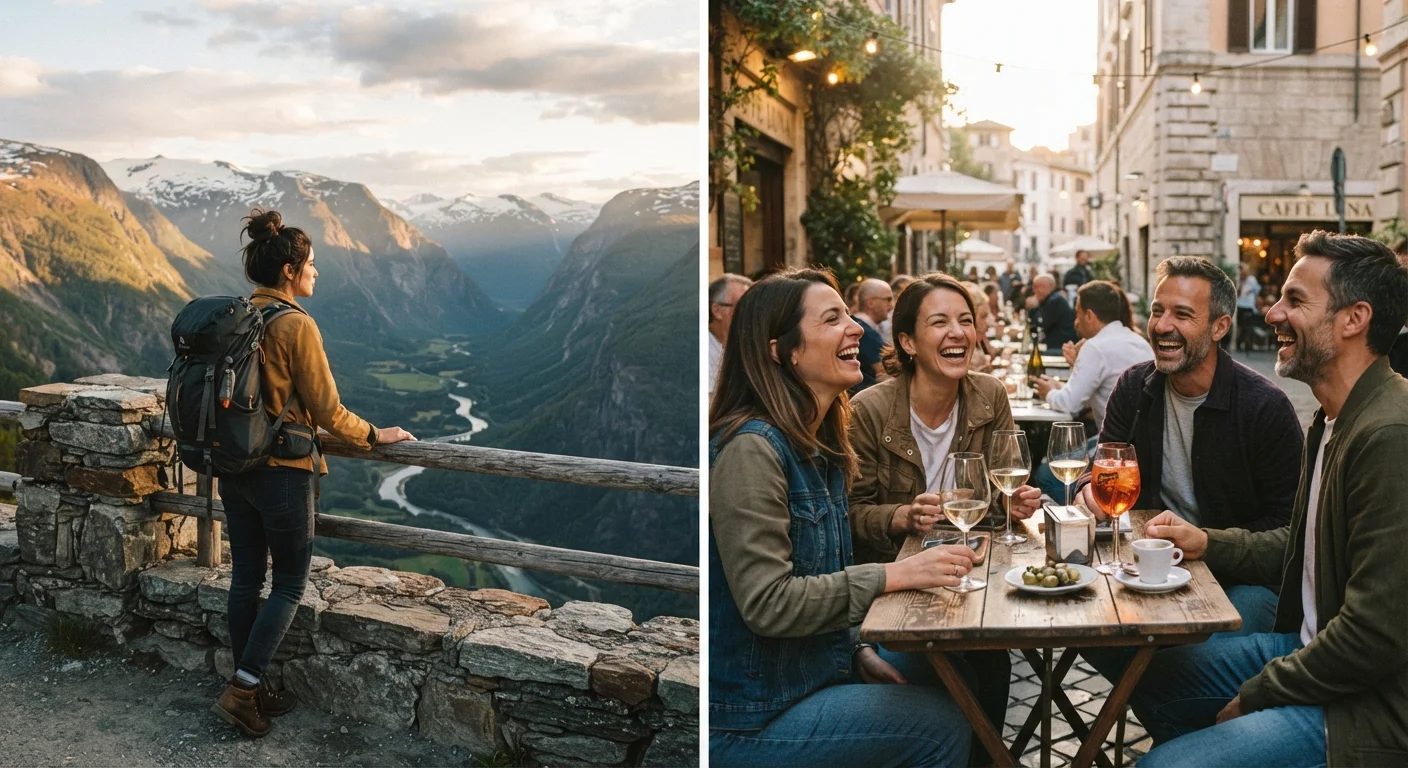
Key Takeaways
- Solo travel costs more per person for accommodation but gives you total control over the itinerary.
- Group travel reduces per-person costs but requires ongoing compromise on timing and activities.
- Safety considerations differ: solo travelers carry all responsibility; groups distribute it but add interpersonal complexity.
- Travel insurance needs can differ between solo and group trips, so review policies separately for each scenario.
- Neither format is universally better; the right choice depends on your destination, budget, and travel personality.
Option A
Solo travel
Full autonomy, personal pace, and complete ownership of every decision.
Best for: Travelers who want to move on their own schedule and are comfortable navigating logistics independently.
Option B
Group travel
Shared costs, shared decisions, and built-in company throughout the trip.
Best for: Travelers who prefer companionship, want to split expenses, or feel more comfortable with others nearby.
If you want to set your own pace without negotiating every meal or detour
Solo travel
Every schedule decision is yours alone. You can linger somewhere interesting or move on without discussion.
If managing unfamiliar logistics in a new destination feels stressful
Group travel
Having others to problem-solve with reduces pressure at airports, border crossings, and confusing transit hubs.
If budget is your primary constraint
Group travel
Shared rooms, split transport, and group dining consistently lower per-person costs across a trip.
If you want the freedom to be spontaneous daily
Solo travel
No consensus is needed, so a last-minute itinerary change costs nothing socially or logistically.
If you are traveling somewhere with genuine safety concerns
Group travel
Traveling with others provides practical backup and reduces vulnerability in unfamiliar or higher-risk environments.
How costs actually compare
The financial picture between solo and group travel is more layered than it first appears. Solo travelers pay a single supplement on many tours and cruise cabins, a surcharge added because the pricing model assumes two people sharing a room. That surcharge can add 50 to 100 percent to accommodation costs on some itineraries. For context on how this plays out specifically on ships, see what to know before booking a solo cabin.
Group travelers split rooms, hire cars together, and share food costs at restaurants, which can meaningfully lower daily spend. The trade-off is less flexibility: if the group decides on a pricier restaurant or a paid excursion you would have skipped, the social pressure to participate is real. Solo travelers spend more per night but spend exactly what they choose.
Transport costs follow a similar pattern. A taxi split four ways is cheap. A solo traveler on the same route pays full fare or plans around public transit. On longer journeys, those differences accumulate. Regional transport trade-offs become especially relevant when you are traveling alone and optimizing for cost over convenience.
| Criterion | Solo travel | Group travel |
|---|---|---|
| Accommodation cost per person | Higher, single supplement common | Lower, shared rooms split cost |
| Schedule flexibility | Full, no coordination needed | Limited by group consensus |
| Daily decision speed | Immediate | Slower, requires agreement |
| Built-in support | None, self-reliant | Present, distributed responsibility |
| Social interaction with locals | Generally higher | Often lower |
| Planning complexity | Lower, one person decides | Higher, multiple inputs needed |
| Transport cost per person | Full cost, no splitting | Lower when shared |
Logistics and planning load
Planning a solo trip means all research, booking, and contingency thinking falls to one person. That is both a burden and a benefit: decisions happen fast, and no one else's preferences delay the process. Group planning involves more coordination, and the more people involved, the more rounds of back-and-forth are typically needed to align on dates, budgets, and activities.
Traveling with companions who have different budgets or interests adds a layer of social management on top of the logistics. Even well-matched travel partners disagree about wake-up times, meal costs, and how much time to spend at any one place. Solo travelers sidestep that friction entirely.
Both formats require deciding how much structure to build into a trip. A solo traveler can swap from a fixed itinerary to a loose plan mid-trip with no consequences. A group usually needs more pre-booking to guarantee everyone has confirmed transport and accommodation. The trade-offs between structured itineraries and open-ended travel apply to both formats, but groups face higher coordination costs when plans shift.
Safety and support on the road
Solo travelers carry full responsibility for their own safety, navigation, and problem-solving. A missed connection, a health issue, or a lost document is handled alone. That is manageable with preparation, but it requires a higher baseline of situational awareness, especially after dark. Practical strategies for staying aware after dark are worth reviewing before any solo trip.
Group travelers have built-in backup. Someone else can watch bags, speak the language better, or make a phone call while you handle something else. That redundancy has genuine value in disorienting or higher-stakes situations. The downside is that groups are more visible and can attract attention in some environments.
Verify insurance coverage for your travel format
Travel insurance policies are not always designed with solo travelers in mind. Some cancel-for-any-reason policies cover the full trip cost only when the primary insured cancels; others handle group bookings differently. Read the policy document carefully, check what counts as a covered reason for cancellation, and consult a licensed insurance agent if you have questions about your specific situation.
Travel insurance needs also shift depending on your format. A solo traveler who cancels has no one to absorb shared costs; a group cancellation can leave others scrambling. Review what each policy covers for solo versus multi-person trips, and check whether group policies cover individual cancellations or only full-group cancellations. Verify terms directly with a licensed insurance professional before purchasing.
Social dynamics and the experience itself
Solo travel creates conditions for a different kind of trip. Without a companion, travelers tend to interact more with locals and other travelers, accept more invitations, and make decisions based purely on personal curiosity. Many solo travelers report stronger memories from those trips, though that is a subjective outcome and varies widely by personality.
Group travel provides consistent company and shared reference points for the experience. Laughing about a missed train together, or navigating a confusing market as a pair, produces a different kind of memory. For travelers who find solitude draining, group travel removes a real source of stress.
The friction in group travel comes from sustained proximity. Travel amplifies personality differences, and small incompatibilities that are easy to ignore at home become harder to overlook when you share rooms and every meal. Deciding between joining a tour group and traveling independently involves similar trade-offs, and the decision often comes down to how well you know the people you would be traveling with.
Trip length matters too. Short trips tend to favor whichever format feels natural to you, since there is little time for friction to build. Longer trips expose the structural differences more clearly. How planning needs differ between short and extended travel covers that shift in more depth.