

Key Takeaways
- Home drainage systems rely on gravity, not pressure, to move wastewater out.
- Every drain fixture has a P-trap that holds water to block sewer gases from entering your home.
- Vent pipes allow air into the drain system so water can flow freely.
- All household drains connect to one main drain line that leads to the sewer or septic system.
- Slow drains are often a sign of a partial blockage in the DWV system, not just the fixture itself.
Home drainage system
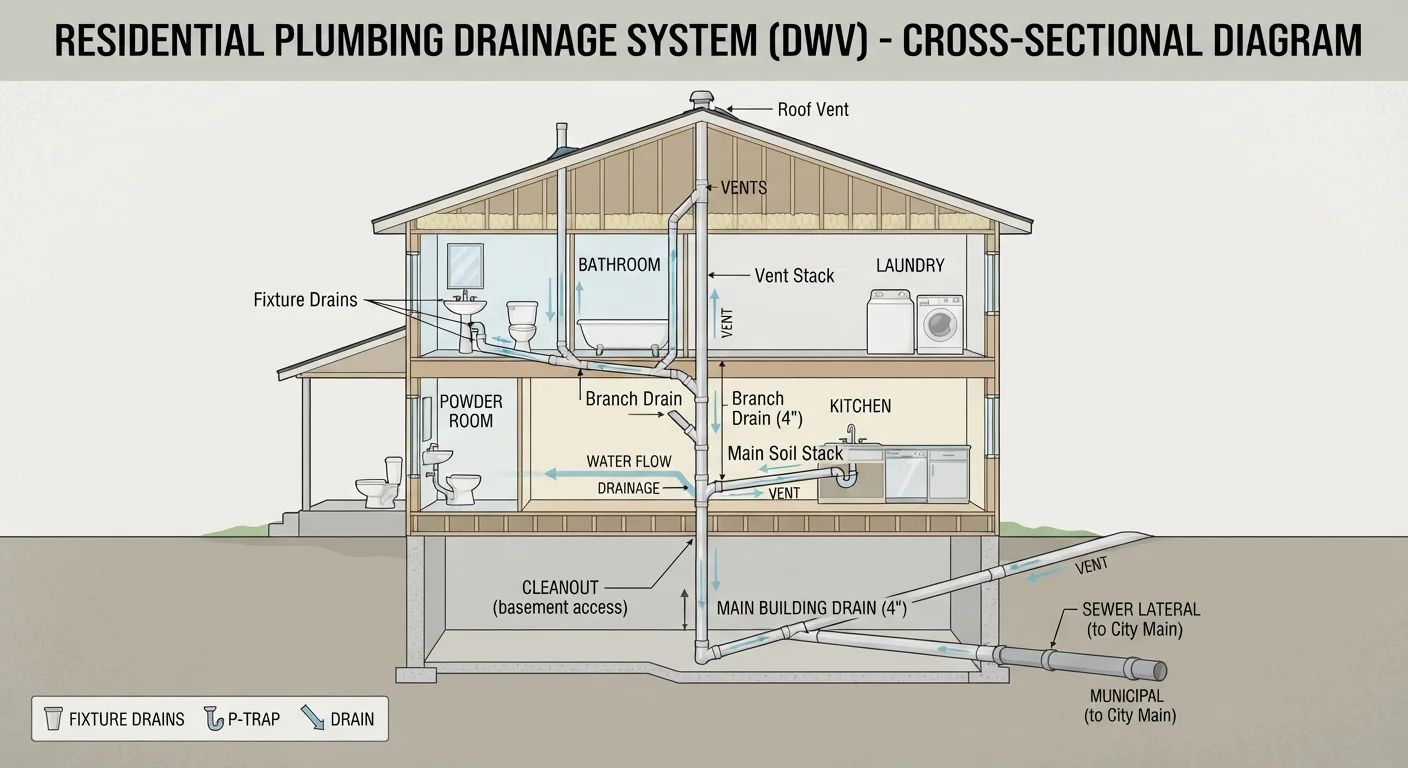
A home drainage system is the network of pipes, traps, and vents that carries wastewater away from sinks, toilets, showers, and appliances to a municipal sewer or private septic system. It works entirely by gravity: pipes slope downward so water flows out without a pump. Every fixture in your home connects to this network, and each connection follows the same basic design principles.
Plumbers refer to this as the DWV system, short for drain, waste, and vent. The vent portion is just as critical as the drain pipes themselves, because without proper airflow, water cannot drain correctly.
The basic path water takes when it leaves your home
When you drain a sink, the water does not disappear instantly. It travels a specific route: from the fixture, through a curved trap, into a branch drain pipe, then into progressively larger pipes until it reaches the main drain line. That main line exits the house through the foundation or basement floor and connects to either a city sewer main under the street or a private septic tank buried in the yard.
Every inch of this path slopes downward, typically about one-quarter inch for every foot of horizontal pipe. That slope is what moves the water without any pump or pressure. If a drain pipe was installed level or with a negative slope, water would pool inside it and solids would accumulate quickly.
Understanding this basic path helps explain most of the drainage problems homeowners encounter: a clog in a branch pipe affects only one fixture, while a clog in the main line affects every drain in the house at once.
What P-traps do and why every fixture has one
Look under any sink and you will see a curved section of pipe shaped roughly like the letter P on its side. This is a P-trap. It holds a small amount of standing water at all times, and that water creates a seal between the interior of your home and the sewer system.
Without that seal, sewer gas, which contains methane and hydrogen sulfide, would flow freely back up through the drain and into your living space. The water barrier costs nothing to maintain; it refills automatically every time you use the fixture. When a drain smells foul after a long period without use, the trap has likely dried out and lost its seal. Running the water for a few seconds restores it.
Toilets have a built-in trap in the ceramic bowl itself, so they do not need a separate P-trap under the floor. Floor drains in basements and laundry rooms also have traps, though these are more prone to drying out since they may go weeks without receiving water.
Keep floor drain traps from drying out
Basement and laundry room floor drains can lose their water seal if they go unused for extended periods. Pouring a cup of water down these drains every few weeks keeps the trap full and the sewer gas barrier intact. Some homeowners add a small amount of cooking oil to slow evaporation in drains that dry out quickly.
Why vent pipes matter as much as drain pipes
Every drain system needs air to work properly. When water flows down a pipe, it pushes the air ahead of it. Without an exit for that displaced air, a vacuum forms behind the flowing water and slows or completely stops the drain. Worse, a strong enough vacuum can siphon the water out of a P-trap, breaking the seal against sewer gases.
Vent pipes solve this by connecting the drain system to the open air, usually through a pipe that exits through the roof. Air enters the system continuously, allowing water to flow freely and traps to stay full. Most homes use a shared vent arrangement where several fixtures tie into one vent stack that runs vertically through interior walls to the roof.
A blocked vent, often from a bird nest or debris, produces symptoms that look like a clog: slow drains, gurgling sounds, or a toilet that bubbles when you drain a nearby sink. Homeowners who notice those gurgling sounds after ruling out a blockage should have the vent stack inspected. Roof-level work on vent stacks should be left to a licensed plumber, since it involves working at height and potentially cutting into finished walls.
Where the system connects to the sewer or septic
The main drain line, typically a four-inch pipe made of ABS plastic, cast iron, or clay depending on the home's age, exits the building and either connects to the municipal sewer lateral under the street or runs to a septic tank on the property. Homeowners are generally responsible for the pipe from the house to the connection point at the street; the municipality owns the main sewer from that point forward. If you rent, your lease and local law determine where your responsibility ends. For a clear breakdown of what renters typically maintain, see what maintenance renters are responsible for.
Most main drain lines also have a clean-out, a capped access point at or near the foundation, that gives a plumber direct access to the pipe for inspection or clearing a blockage without opening walls. Knowing where your clean-out is located saves time when you need to call for service.
Gutters and outdoor drainage are a separate system from the household DWV network, but they can affect your home's foundation drainage in related ways. How gutters direct water away from your home covers that side of exterior water management.