

Key Takeaways
- An entryway needs only a few specific elements: a landing spot for keys, a place to hang outerwear, and seating for shoes.
- Clutter accumulates at entries because there are no systems to intercept it before it spreads further into the home.
- More storage is not always the solution; unused organizers and decorative excess often make entries harder to use.
- Small households can maintain a functional entry with minimal furniture by applying consistent daily habits.
Stops clutter before it enters the home
When there is a designated spot for coats, bags, and shoes at the door, those items rarely migrate further inside. The entry acts as a filter, keeping the rest of the home cleaner by default.
Reduces morning friction significantly
A consistent landing zone for keys, wallets, and daily-carry items means less time searching before you leave. This is one of the most immediate practical payoffs of a well-organized entry.
Requires very little space to work well
Even a narrow apartment hallway can hold hooks, a small tray, and a low shelf. Functional entryways scale down to almost any footprint.
Low setup cost compared to other rooms
Wall hooks, a simple bench, and a tray or small bowl are all most households need. There is no requirement for custom cabinetry or expensive furniture.
Supports household habits across all members
When the system is visible and obvious, children and other household members are more likely to use it. The physical cues do some of the behavioral work.
Systems break down without consistent use
An entry organizer only works if everyone in the household uses it every time. One person leaving a bag on the floor can prompt others to do the same, and the system quietly collapses.
Overcrowded entries become harder to use than bare ones
Too many hooks, bins, or decorative pieces create visual noise and reduce usable space. An overloaded entry often signals that the household has outgrown its system, not that it needs more storage.
Seasonal items require active management
Winter coats, umbrellas, and boots will overwhelm a small entry if they are not rotated out when the season changes. Without a seasonal review, capacity shrinks without warning. See how to manage seasonal rotation for a practical approach.
Shared households face competing habits
When multiple adults share a space, different routines about where things land can undermine any single system. Agreement on the setup matters as much as the setup itself.
Our Verdict
A functional entryway is less about square footage or storage volume and more about having the right few systems in the right places. The gains are real: less time searching for lost items, fewer coats piled on chairs, and a calmer start and end to every day. The tradeoff is that the systems only hold if every household member uses them consistently.
Anyone who regularly loses keys, wrestles with coat piles, or feels their home's disorder starts right at the door.
What a functional entryway actually does
The entryway is the first point of contact between your household and the outside world, every single day. What happens there in the first 30 seconds after you walk in shapes whether the rest of the home stays organized or slowly absorbs the disorder that starts at the door.
A well-functioning entry does two things: it gives daily-use items a consistent home, and it stops things from drifting deeper into the house. That is the whole job. The entry does not need to be beautiful or large to do it well.
For context on how the entry fits into a broader organizational approach, the complete home organization starting point covers every major area in sequence.
What the entry actually needs
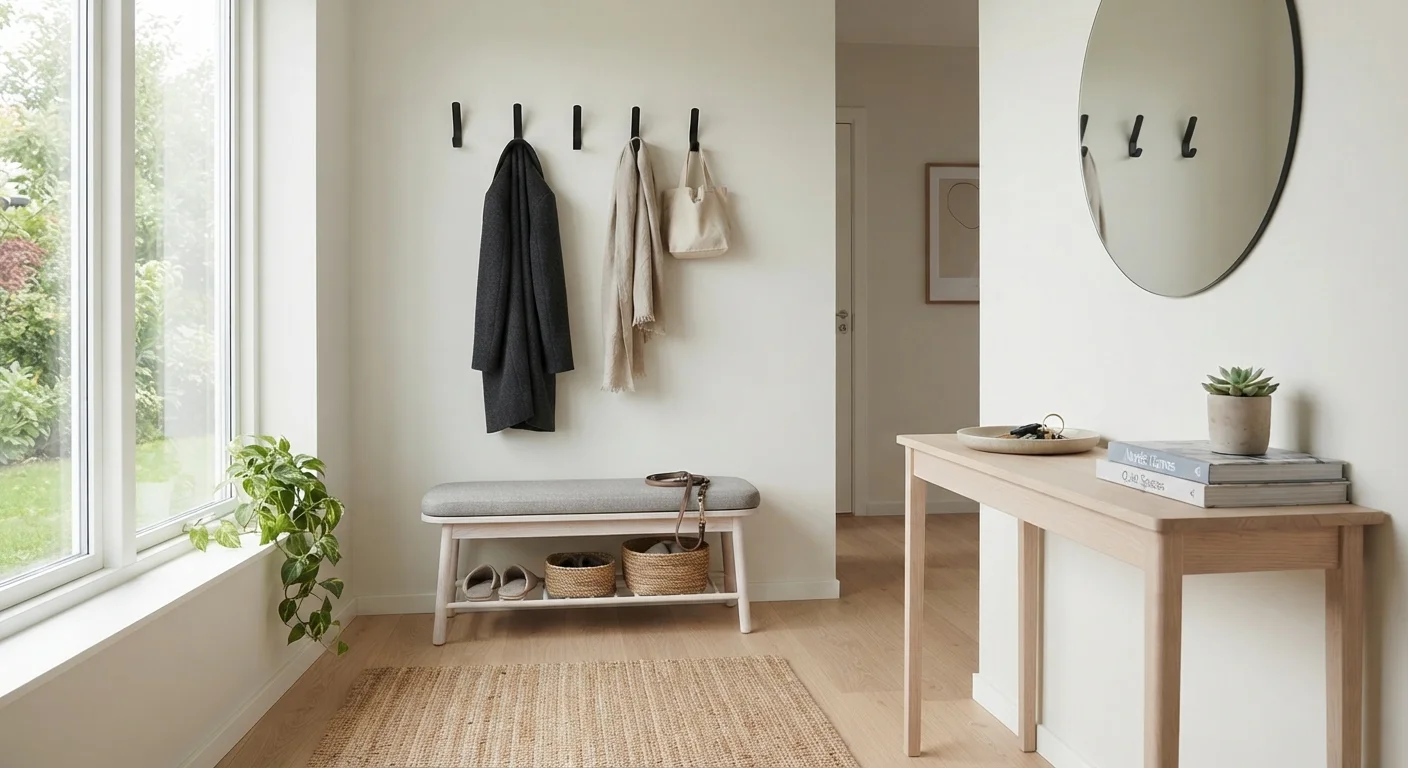
Most entries need fewer things than homeowners expect. The functional requirements are narrow:
- A place to hang outerwear (wall hooks or a rack, positioned within arm's reach of the door)
- A spot for shoes, whether a low shelf, a tray, or a bench with storage underneath
- A small tray, bowl, or drawer for keys, cards, and pocket contents
- Adequate lighting to see what you are doing, especially at night
That is a short list. The temptation is to add more: a full coat closet, a charging station, a mail sorter, baskets for each family member. Some of those additions are genuinely useful. Many are not, and they consume space that was already tight.
Renters have more options than they think
Command hooks and adhesive strips rated for heavier loads can hold coats and bags without wall damage. A freestanding rack or narrow console table adds function without any permanent installation. Check your lease before drilling, but know that a lack of wall access does not mean a lack of solutions.
The principles behind organizing everyday storage apply here too: assign every category a fixed location, keep capacity proportional to use, and remove anything that does not earn its place regularly.
The case for a dedicated entryway system
Stops clutter before it enters the home
When there is a designated spot for coats, bags, and shoes at the door, those items rarely migrate further inside. The entry acts as a filter, keeping the rest of the home cleaner by default.
Reduces morning friction significantly
A consistent landing zone for keys, wallets, and daily-carry items means less time searching before you leave. This is one of the most immediate practical payoffs of a well-organized entry.
Requires very little space to work well
Even a narrow apartment hallway can hold hooks, a small tray, and a low shelf. Functional entryways scale down to almost any footprint.
Low setup cost compared to other rooms
Wall hooks, a simple bench, and a tray or small bowl are all most households need. There is no requirement for custom cabinetry or expensive furniture.
Supports household habits across all members
When the system is visible and obvious, children and other household members are more likely to use it. The physical cues do some of the behavioral work.
The cumulative effect of these advantages is a household that runs with less daily friction. Morning rushes get shorter. Coats stop living on dining chairs. The entry becomes a reliable reset point rather than a bottleneck.
For households with children, the strategies for organizing kids' spaces carry over directly: low hooks at child height, a labeled bin for school bags, and a consistent shoe spot make children more likely to participate without being prompted.
Where entryway systems break down
Systems break down without consistent use
An entry organizer only works if everyone in the household uses it every time. One person leaving a bag on the floor can prompt others to do the same, and the system quietly collapses.
Overcrowded entries become harder to use than bare ones
Too many hooks, bins, or decorative pieces create visual noise and reduce usable space. An overloaded entry often signals that the household has outgrown its system, not that it needs more storage.
Seasonal items require active management
Winter coats, umbrellas, and boots will overwhelm a small entry if they are not rotated out when the season changes. Without a seasonal review, capacity shrinks without warning. See how to manage seasonal rotation for a practical approach.
Shared households face competing habits
When multiple adults share a space, different routines about where things land can undermine any single system. Agreement on the setup matters as much as the setup itself.
Most of these failure modes share a common cause: the system was set up but never maintained. The household rules that prevent clutter matter as much as any physical setup. A one-in, one-out approach applied to coats and bags keeps entry capacity from silently shrinking over months.
The other failure mode is overbuilding. Buying more organizers to solve a clutter problem at the entry rarely works if the root issue is that items do not have a clear, obvious place to go. Simplify the system before expanding it.