

Key Takeaways
- Decluttering before buying storage containers prevents the most common organizing mistake.
- Grouping items by how and when you use them works better than grouping by what they are.
- Containment within a drawer stops items from migrating and mixing over time.
- A drawer without a defined purpose will collect whatever doesn't have a home elsewhere.
- Maintenance is simpler when every item has one assigned spot it always returns to.
Everyday storage organization
Everyday storage organization is the practice of arranging frequently used items in drawers, shelves, and compartments so they are easy to find and return. It focuses on how things are grouped and accessed, not just how they look. The goal is a system that holds up with minimal effort over time.
Organization professionals often distinguish between 'zones' (areas designated by activity type) and 'categories' (groups by item type); both frameworks apply well to drawer-level storage.
Why drawers fall apart
A drawer becomes chaotic for one consistent reason: it has no defined purpose. Without a clear role, a drawer absorbs whatever doesn't have an obvious home. Tape ends up next to takeout menus, dead batteries sit beside phone chargers, and the whole thing becomes a pile rather than a storage system.
The same dynamic appears in closets, cabinets, and shelves. The container is not the problem; the absence of a guiding principle is. Before touching a single organizer bin, it is worth understanding what actually makes storage work over time.
For a broader view of how these principles connect across your whole home, the complete starting point for home organization walks through each major area in practical terms.
The four principles that make storage functional
1. Define the drawer's purpose before filling it. Every drawer should answer one question: what activity or need does this support? A drawer near the stove can hold cooking tools. A drawer near the door can hold keys, mail, and transit cards. When the purpose is clear, it is obvious what belongs and what does not.
2. Declutter before you contain. Adding bins and dividers to a full, unsorted drawer just organizes the problem. Empty the drawer, discard what is broken or expired, and relocate items that belong elsewhere. Only then does containment make sense. This is one of the most common traps people fall into, and our article on why buying organizers makes clutter worse explains the pattern in detail.
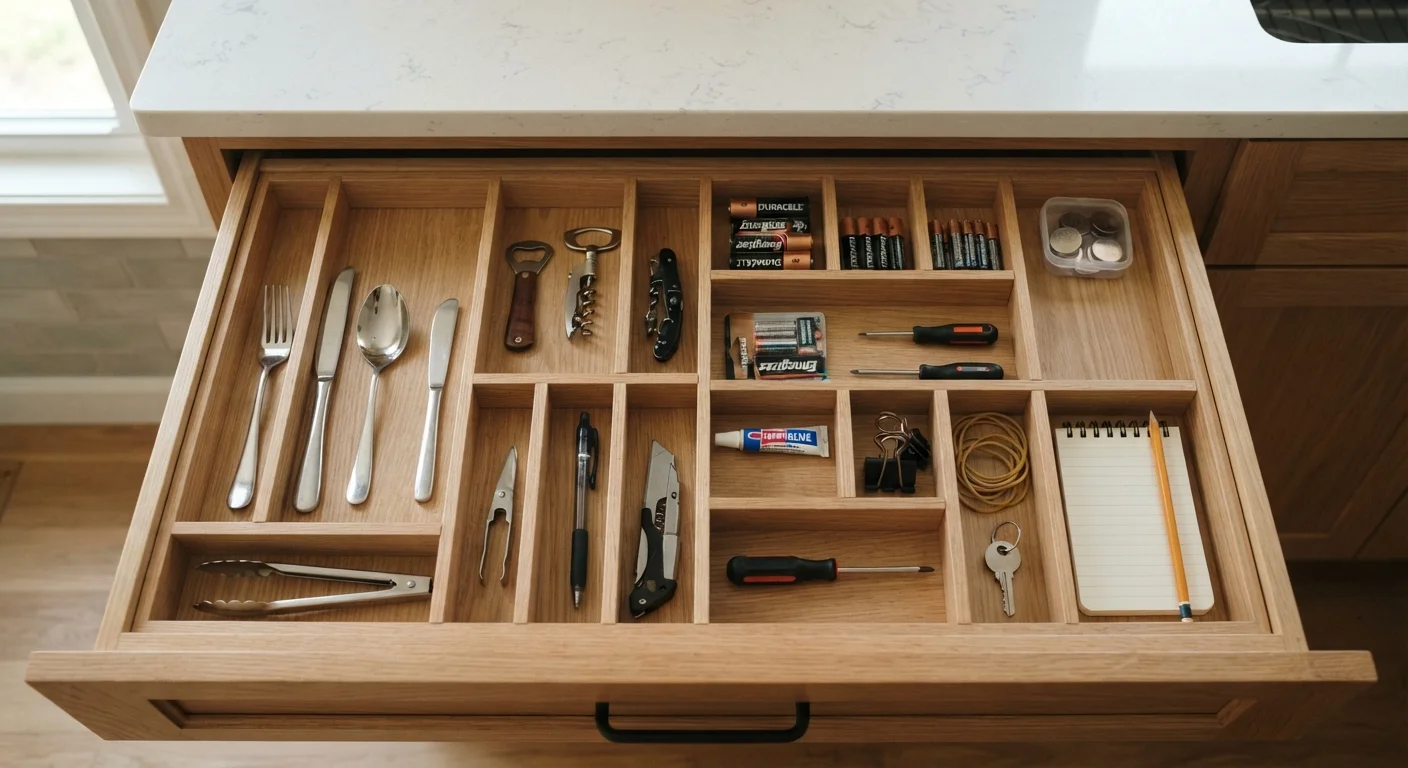
3. Group by use, not just category. Grouping all batteries together makes sense. But grouping everything you need to pay a bill, including stamps, a pen, and return envelopes, makes more practical sense. Use-based grouping means fewer steps when you actually need something.
4. Contain each group. A small box, a divided tray, or even a folded piece of cardboard separates groups within a drawer and stops them from merging back into chaos. Containment does not require expensive materials. It requires consistent boundaries.
Test your system before buying containers
Use rubber bands or tape to temporarily mark off zones in a drawer before purchasing dividers. Live with the arrangement for a week. You will quickly learn whether the groupings and sizes actually fit how you use the space, which prevents buying the wrong organizers.
Applying these principles beyond drawers
The same four steps work in any storage area. A bathroom cabinet benefits from defined zones (daily use items versus backup supplies). A coat closet works better when accessories have a contained spot rather than piling on shelves. Seasonal items stored in bins stay accessible when labeled by purpose rather than by season alone. Our seasonal organization guide covers how to rotate and reassess those categories a few times a year.
Paper clutter is a specific case where use-based grouping matters most. Sorting documents by what action they require (pay, file, shred) is more useful than sorting by type. The guide to managing paper clutter breaks that system down clearly.
Closets present a slightly different challenge because the volume of items is larger, but the principles are the same. Closet organization approaches vary, and the right one depends on how you actually use the space, not how it looks in photos.
What maintenance actually looks like
An organized drawer does not stay that way automatically. Maintenance takes about two minutes per drawer if the system is well-designed: return items to their spots, remove anything that has migrated in, and check occasionally that the categories still match how you use the space.
When a drawer starts sliding back into disorder, the usual cause is that the system no longer fits the need. Someone added new items without adjusting the layout. A category grew too large for its container. A purpose shifted but the drawer contents did not. These are fixable problems, not signs of failure.
Consistent small habits outperform periodic large reorganizations. The household rules that prevent clutter article covers simple policies, like one-in, one-out, that reduce how often a full reset is needed.
23 min
Average time spent daily looking for misplaced items
Cited in various workplace and home productivity research as a general estimate for time lost to disorganization.
1 in 4
Adults who describe at least one drawer as 'unusable'
A commonly referenced figure in home organization surveys about the prevalence of junk-drawer disorder in American households.