

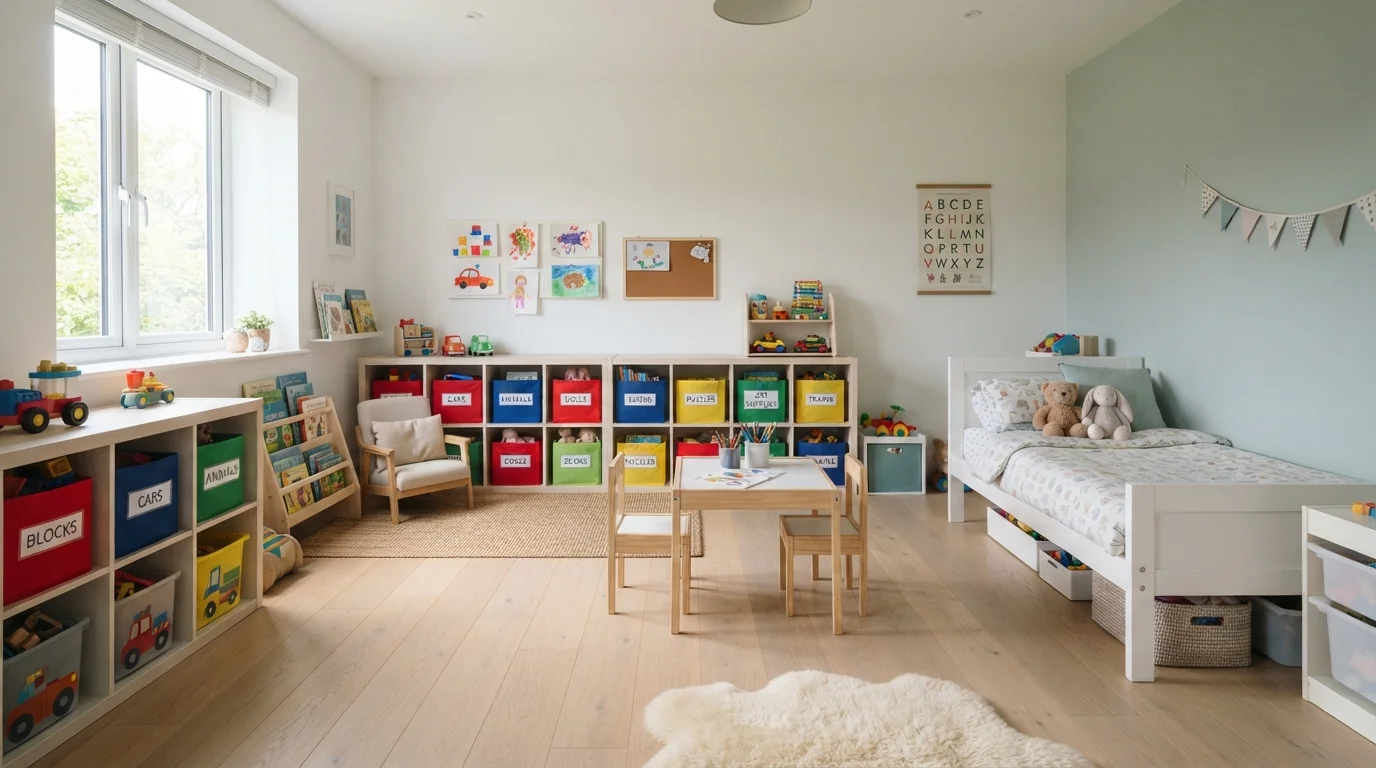
Key Takeaways
- Systems designed around a child's natural behavior require less enforcement from adults.
- Reducing the total volume of items in a space is the single most effective first step.
- Low, accessible storage lets children put things away without adult help.
- Age-appropriate expectations prevent frustration on both sides.
- Consistent boundaries around new items help prevent clutter from rebuilding.
What you will need
Why kids' rooms resist staying organized
Children's spaces accumulate mess for straightforward reasons: too many items competing for too little storage, storage that is physically hard for kids to use, and organizational systems that assume habits kids haven't developed yet. Expecting a seven-year-old to maintain the same kind of order an adult manages is not realistic. The goal instead is to design a space where the default behavior, the path of least resistance, produces something close to tidy.
This means shifting the work away from enforcement and toward setup. A well-designed system does not depend on a child's motivation. It makes putting something away as easy as dropping it on the floor. That requires two things: fewer items overall, and storage the child can actually reach and use without help.
The strategies below build on that principle. They are ordered to address the most common barriers first. If your home tends to accumulate clutter faster than you can manage it, the household rules that prevent clutter article covers boundary-setting that helps the whole house, not just children's areas.
How to set up a system that holds
Cut the volume before adding any storage
Go through everything in the space and remove items the child has outgrown, duplicates, broken pieces, and things that haven't been touched in several months. This step happens before buying a single bin or shelf. The right amount of stuff for a child's room is less than you probably think: a manageable collection means cleanup takes two minutes, not twenty.
Involve the child in this step if their age allows it. Children as young as four can often say whether they still like something. Frame it as making room for things they actually use, not as taking things away.
Assign storage at the child's physical level
Move the most-used items to shelves, hooks, and bins between knee and shoulder height for the child. Anything the child cannot reach independently will end up on the floor. Everyday items, books, current toys, art supplies, belong at accessible height. Seasonal items or rarely used things can go higher or in closet bins that adults manage.
Open bins without lids work better than lidded containers for everyday items. The fewer steps required to put something away, the more likely it gets done.
Create one designated drop zone per category
Assign one home to each broad category: a bin for stuffed animals, a shelf for books, a basket for building toys. Do not subdivide further than the child can manage. A single-step sort, this goes in the toy bin, is far more sustainable than a detailed sorting system with multiple small compartments.
The categories should reflect how the child actually plays, not how a retail display organizes things. If cars and blocks always get mixed together during play, one bin for both is a practical choice.
Set a daily reset, not a full tidy
A once-daily reset, typically before bed or after school, is more sustainable than asking children to tidy continuously throughout the day. Keep the reset short enough that it genuinely takes five minutes or less when the system is working. If it regularly takes longer, that is a signal the volume is still too high or the system needs adjustment.
Stay present for the reset with younger children, not doing it for them, but alongside them. Participation habits form through repetition with support, not through expectation alone.
Manage incoming items to prevent rebuild
A well-organized space will gradually return to clutter if new items arrive faster than old ones leave. Consider applying a one-in, one-out approach to toys and books: when something new comes in, one comparable item is donated or removed. This is especially practical around birthdays and holidays.
This does not mean restricting gifts or purchases harshly. It means keeping a rough balance between what comes in and what goes out, so the system stays workable without a full reset every few months.
Once the system is in place, a seasonal review every few months keeps it current as kids grow, interests shift, and toy volume changes. What works at age five often needs adjustment by age eight.
Common mistakes that undo the work
The most frequent reason a children's room reverts to chaos quickly is that the organizing step happened without a prior reduction in volume. Buying bins and baskets feels productive, but when there are more items than the storage can comfortably hold, the system fails within days. The problem with buying organizers before decluttering is well documented: storage purchases often mask the problem rather than solve it.
A second common mistake is organizing for how you want the space to look rather than how the child actually uses it. If a child always builds with blocks on the floor near the window, a block bin in the closet will stay empty. Put storage where the activity happens.
A third is setting expectations that require adult-level executive function. Young children cannot reliably categorize, sequence, or remember multi-step routines. A single-step rule, everything goes in this bin, outperforms a detailed sorting system every time. Complexity can be added gradually as children get older and demonstrate readiness. For guidance on applying these same principles beyond the kids' room, the principles of organizing everyday storage translate well to shared household spaces.
Adjust the system as kids grow
What works for a four-year-old will not suit an eight-year-old. As children develop more organizational capacity, you can introduce finer categories and expect more independence. Revisit the setup when a child's interests shift significantly or when tidying starts taking noticeably longer than it used to.