

Key Takeaways
- GPS trackers work by receiving satellite signals and relaying location data through a separate network, usually cellular or Bluetooth.
- Accuracy varies by environment: open sky gives the best results, while buildings and dense foliage degrade precision significantly.
- Most real-time trackers require a recurring subscription to transmit data over cellular networks.
- Tracking another person without their knowledge or consent is illegal in many jurisdictions.
- No tracker can guarantee recovery of a stolen item; location data tells you where something is, not that you can retrieve it safely.
Start here
What a GPS tracker actually does
Next
The main types of GPS trackers
Then
Accuracy and signal: the honest picture
When you're ready
Privacy and legal considerations
Apply it
Practical use cases worth considering
What a GPS tracker actually does
A GPS tracker is a device that determines its own geographic position and then reports that position so you can view it. The position-finding part uses the Global Positioning System, a network of satellites maintained by the US government. The tracker's receiver picks up signals from multiple satellites simultaneously and calculates its location through a process called trilateration, measuring how long each signal took to arrive.
That location calculation happens inside the device. What varies between tracker types is how the data gets from the device to your phone or computer. That transmission step requires a separate communication channel, and the channel you use shapes almost everything about cost, range, and reliability.
GPS is only one part of the system. Think of it as the measuring instrument. The communication layer, whether cellular, Bluetooth, or Wi-Fi, is the delivery service. Understanding both parts helps set realistic expectations before you buy anything.
Trilateration
The method a GPS receiver uses to calculate its position by measuring the travel time of signals from at least four satellites simultaneously.
Multipath error
A positioning inaccuracy that occurs when GPS signals bounce off buildings or other surfaces before reaching the receiver, making the calculated location incorrect.
Passive logger
A GPS device that records location data to its own internal storage without transmitting anything, so the data can only be reviewed after physically retrieving the device.
Crowdsourced network
A system used by Bluetooth item finders where other users' devices, without their knowledge of the specific item, anonymously relay a lost tracker's location back to the owner.
Update interval
How often a GPS tracker sends a new location report to the app or server. Shorter intervals give fresher data but drain the battery faster.
The main types of GPS trackers
Trackers fall into a few broad categories based on how they transmit data.
Real-time cellular trackers
These devices contain a cellular radio, similar to a SIM card in a phone. They send location data over mobile networks to a cloud server, which you access through an app or website. Updates can arrive every few seconds to every few minutes. Because they use cellular infrastructure, they work anywhere with mobile coverage and can track a moving vehicle or person in close to real time. The trade-off is cost: most require a recurring data subscription, and battery consumption is high.
Bluetooth item finders
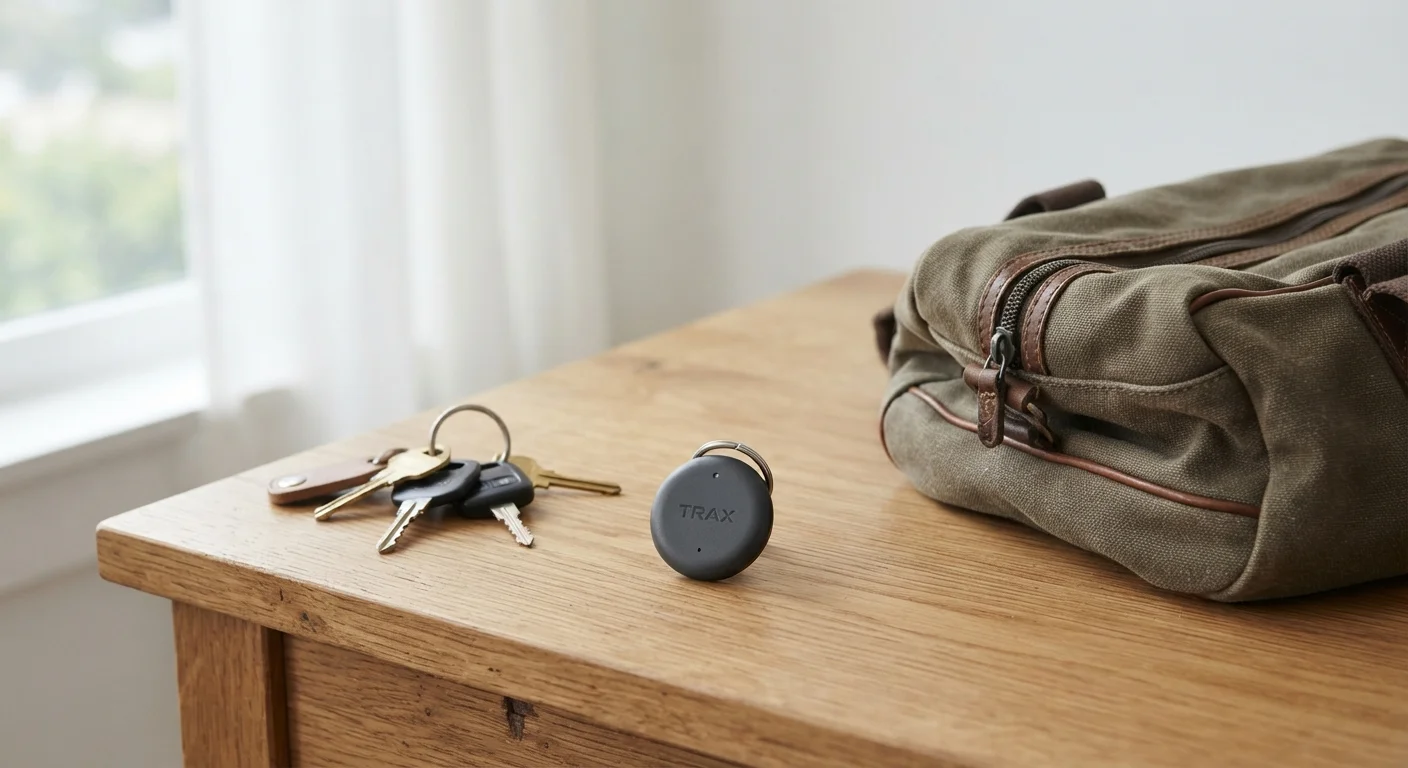
These small, coin-sized devices do not communicate directly with satellites for positioning. They use Bluetooth to connect to your smartphone when you are nearby, and when out of range, they rely on a crowdsourced network of other users' devices to relay an approximate location. Range without the network is typically 30 to 100 feet. They are inexpensive, subscription-free, and long-lasting on battery, but they are not real-time trackers in the cellular sense. For lost keys or a misplaced bag around the house, they work well. For tracking a vehicle across town, they do not.
Passive GPS loggers
A passive logger records location data to internal storage without transmitting anything. You retrieve the stored history by physically connecting the device to a computer. These are useful for analyzing routes after the fact, such as reviewing a vehicle's travel history, and they have very long battery life. They offer no live location updates.
Accuracy and signal: the honest picture
Under open sky with a clear view of multiple satellites, a consumer GPS receiver is typically accurate within 3 to 5 meters. That is good enough to identify which parking lot a car is in, but not which parking space. In practice, accuracy degrades in several common situations.
- Dense urban areas with tall buildings on multiple sides cause signal reflections called multipath error, which skews the calculated position.
- Indoor environments block satellite signals almost entirely. The tracker may fall back on cellular triangulation or Wi-Fi positioning, which are typically accurate only to 20 to 100 meters.
- Heavy forest canopy absorbs and scatters signals.
- Tunnels, parking garages, and basements produce no GPS signal at all.
Update frequency also affects the picture you see. A tracker that transmits every 60 seconds shows where a vehicle was one minute ago, not necessarily where it is right now. For a stationary item, this is irrelevant. For a moving vehicle, a minute of gap at highway speed is several miles.
If you use a mapping app regularly, you may have encountered similar limitations abroad. GPS app accuracy can be inconsistent in ways that are worth understanding before you rely on any location technology in an unfamiliar place.
Battery life and connectivity trade-offs
The single biggest factor in battery life is transmission frequency. Every time a cellular tracker sends a location update, it wakes its radio, connects to the network, sends data, and goes back to sleep. Doing this every 10 seconds is extremely power-intensive. Doing it every 5 minutes is far less so.
Most cellular trackers allow you to configure update intervals through their app. Choosing a longer interval extends battery life but reduces location freshness. For a parked vehicle you want to monitor for theft, a 1-minute interval may be plenty. For a child walking between school and home, you might want 15-second updates, accepting the faster battery drain.
Hardwired vehicle trackers avoid the battery problem entirely by drawing power from the car's electrical system. They are a common choice for fleet monitoring or vehicle recovery use cases.
Bluetooth item finders sidestep the battery problem differently: because Bluetooth transmits at very low power and only pings nearby devices rather than a cellular tower, a small coin battery can last a year or more.
Match the update interval to your use case
Before lowering the update interval to the minimum, think about how you will actually use the location data. A parked car monitored for theft rarely needs updates faster than every 2 to 5 minutes. Adjusting this setting is one of the most effective ways to extend battery life without losing meaningful coverage.
Privacy and legal considerations
GPS trackers create location records, and those records have real privacy and legal implications. In the US, the legality of using a tracker on another person or their property varies by state. As a general principle, tracking a person without their knowledge or consent is illegal in most jurisdictions, and courts have repeatedly treated covert tracking as a form of surveillance subject to legal restriction. If you are considering tracking a vehicle that another adult uses, even one you own, you should verify the laws in your state before proceeding. Consult a legal professional if the situation is not straightforward.
For parents tracking minor children, the legal picture is generally clearer, but transparent communication about tracking builds trust and models responsible behavior.
Manufacturers of major Bluetooth tracker ecosystems have added anti-stalking features that alert users when an unknown tracker has been traveling with them. This is a meaningful development, though it does not eliminate all misuse scenarios.
Location data stored in the cloud is also subject to data security risks. Review any tracker app's privacy policy to understand how long location history is retained and who can access it. For a broader look at how physical monitoring technology compares, home security cameras raise similar questions about realistic benefit versus expectation.
Practical use cases worth considering
GPS trackers are genuinely useful in specific, bounded situations. Here are a few that align with how the technology actually performs.
Vehicles
A hardwired or magnetic cellular tracker in a vehicle lets you verify its location if it is stolen. It does not guarantee recovery: acting on live location data in a theft situation should always involve law enforcement, not personal intervention. The tracker gives police a starting point; what happens next depends on many factors outside your control.
Pets
GPS collars can help locate a dog or cat that has escaped a yard. Battery life and collar weight are real constraints for smaller animals. A comparison of microchips, ID tags, and GPS collars covers the trade-offs in detail, since GPS is one of several complementary identification options rather than a standalone solution.
Luggage and travel gear
Slipping a small cellular tracker into checked luggage gives you real-time visibility into where an airline has routed your bag. Coverage depends on cellular signal in the airport and destination country. When traveling, note that some countries restrict the import or use of certain radio-frequency devices; check the rules for your destination. A complete trip-planning walkthrough can help you account for logistics like this before departure.
Keys and everyday items
Bluetooth item finders are well-suited to keys, wallets, and bags that stay within a reasonable distance of your phone. They work best as a tool for finding items you misplace at home or nearby, not for recovering items taken far away.