

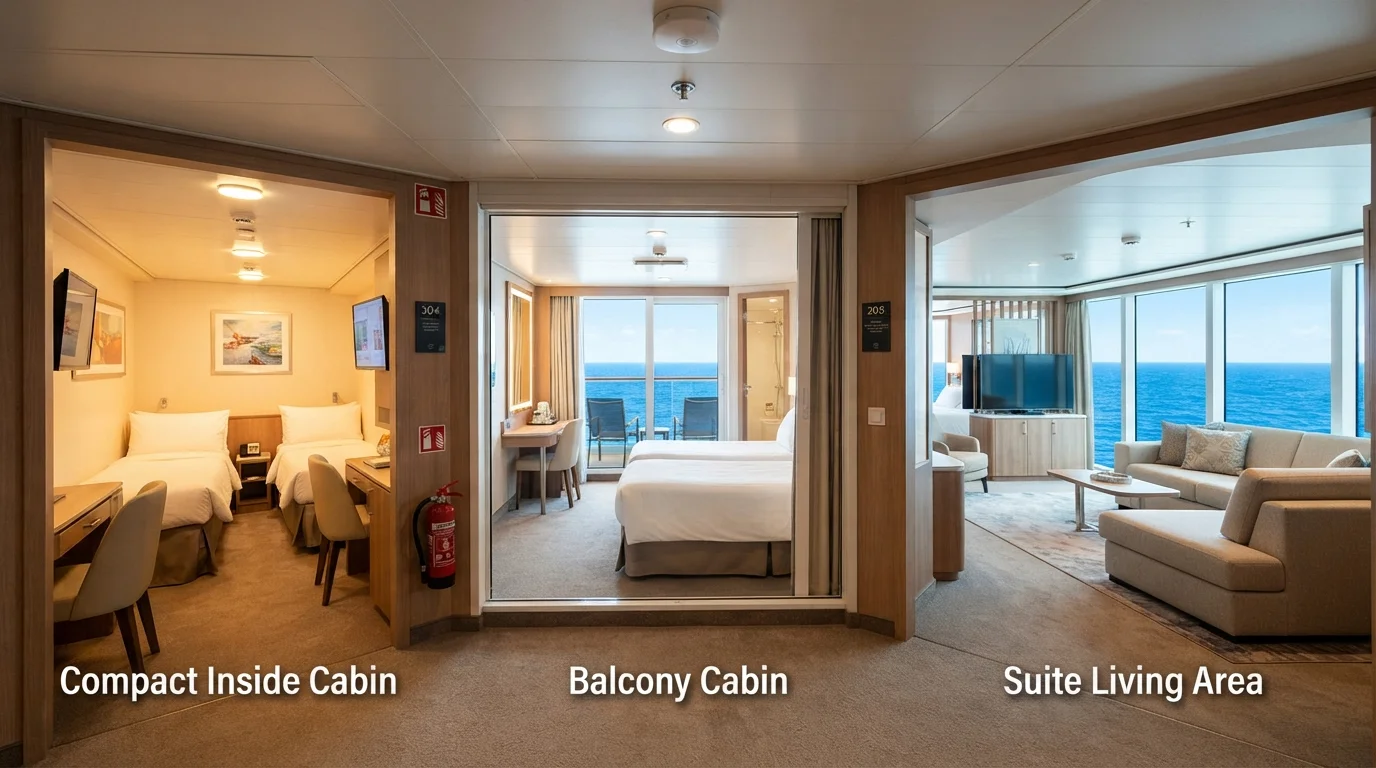
Key Takeaways
- Inside cabins cost less and suit passengers who plan to spend most time off the ship.
- Balcony cabins add private outdoor space and natural light, which matters most on scenic routes.
- Suites include extra amenities and priority access, but the price gap is significant.
- Location on the ship (deck, midship vs. bow) affects comfort regardless of cabin category.
- Accessibility needs require direct verification with the cruise line before booking.
Our Verdict
Cabin category should follow how you actually plan to use the room. Inside cabins make financial sense for port-heavy itineraries where you sleep and shower onboard. Balcony cabins earn their cost on scenic or relaxed sailings. Suites add tangible perks, but only at a price that few itineraries fully justify.
| Best for | Recommended |
|---|---|
| Budget-conscious travelers on port-intensive itineraries | Inside cabin |
| Couples or solo travelers on scenic routes like Alaska or Norway | Balcony cabin |
| Travelers who want priority boarding, butler service, and extra space | Suite |
| Families needing room for multiple people without booking two cabins | Suite or large balcony cabin |
What the cabin categories actually include
Cruise ships divide cabins into four broad tiers: inside (no window), oceanview (fixed porthole or window), balcony (private outdoor space), and suite (expanded living area with added services). Oceanview sits between inside and balcony in price and use, though many ships have reduced that category as balcony inventory has grown.
Every cabin, regardless of category, includes a bed or convertible beds, a private bathroom, storage, a television, and climate control. The differences above that baseline involve natural light, outdoor access, square footage, and what services the ship attaches to higher categories.
Suite tiers vary by cruise line. Some lines use the label for any cabin above a standard balcony. Others reserve it for multi-room configurations with a separate living room, concierge access, specialty dining reservations, and priority embarkation. Read the specific line's cabin descriptions carefully rather than assuming a suite on one ship matches a suite on another.
Inside cabins: the trade-offs
Inside cabins have no window. That is the defining feature, and it shapes the experience more than size alone. Without natural light, you lose a reliable sense of time, which some passengers find disorienting on longer voyages. Blackout conditions can also help heavy sleepers, which some travelers consider an advantage.
The cost difference between an inside cabin and a balcony on the same sailing can range from a few hundred dollars to over a thousand, depending on the ship and itinerary. On a Caribbean sailing where you spend most daylight hours ashore or at the pool deck, the inside cabin is a practical choice. On a seven-night Alaska Inside Passage sailing, where glaciers and wildlife pass by at all hours, the absence of a window or balcony is a genuine loss. See planning tips for an Alaska Inside Passage cruise for how itinerary type affects this decision.
Midship inside cabins on lower-to-middle decks tend to have the least motion, which matters if you are prone to seasickness.
Balcony cabins: when the cost is worth it
A balcony adds a private outdoor space, typically just large enough for two chairs and a small table. The real value is access to outside air and unobstructed views without competing for deck space. On sea days, this matters. On scenic sailings through fjords, glaciers, or island chains, it matters considerably more.
Balcony cabins vary in size. Aft-facing balconies (at the ship's stern) are often larger than standard side balconies and offer a distinctive wake view. Obstructed balconies, where a lifeboat or structural element partially blocks the sightline, are priced lower and worth considering if you want outdoor access without paying full balcony rates.
Check the deck plan before you book
Cruise lines publish deck plans on their websites showing exact cabin locations. Cross-reference your cabin number against the plan to identify what is above, below, and beside it. A few minutes with the deck plan can prevent a cabin next to a late-night venue or directly under the pool deck.
The route you choose affects how much you will use a balcony. Eastern Caribbean itineraries with long sea days reward balcony access more than port-heavy western routes where you are off the ship most of the day.
Suites: what you actually get for the premium
Suite pricing varies widely, but the gap between a standard balcony and an entry-level suite is often 50 to 100 percent of the base fare. What you receive in return depends entirely on the cruise line and ship.
Common suite inclusions across most lines: a larger balcony, a separate seating area, premium bath amenities, and priority boarding and disembarkation. On lines with a dedicated suite program, you may also get access to a private restaurant, a reserved sun deck, a butler or dedicated cabin attendant, and complimentary specialty dining credits.
For families or groups traveling together, a suite can consolidate two cabins into one, which sometimes narrows the price gap. For solo travelers or couples on a one-week sailing, the added amenities are real but the value depends on how much time you spend in the cabin. Understanding what cruise fares include helps clarify whether suite perks offset costs you would otherwise pay separately.
Location on the ship matters as much as category
Deck position and placement along the ship's length affect comfort independently of cabin type. Midship cabins on middle decks experience less pitch and roll than cabins at the bow or stern. High decks feel more motion in rough seas. Low decks near the waterline are more stable but may have obstructed or no natural light even in oceanview categories.
Noise is another variable. Cabins directly below a pool deck, a buffet, or a nightclub absorb more sound, especially late at night or early in the morning. Cabins near the elevator banks are convenient but tend to have more corridor traffic.
If you have mobility considerations, cabin location becomes a specific planning factor. Accessible cruising planning covers what to ask the cruise line about cabin placement, bathroom configuration, and ship-wide accessibility before you book.
Packing for a cruise is easier once you know your cabin size, since storage varies between inside and suite categories.