

Key Takeaways
- Every itinerary lists an embarkation port, a sequence of ports of call, sea days, and a disembarkation port.
- Sea days are full days spent sailing with no port stop; they are not wasted time but a core part of the experience.
- Port times shown on an itinerary are arrival and departure times for the ship, not how long you personally have ashore.
- Itineraries vary by voyage length, region, and ship type, affecting how much ground the route covers.
- All itinerary details, especially port times and visa requirements, should be verified with the cruise line and official government sources before booking.
Cruise itinerary
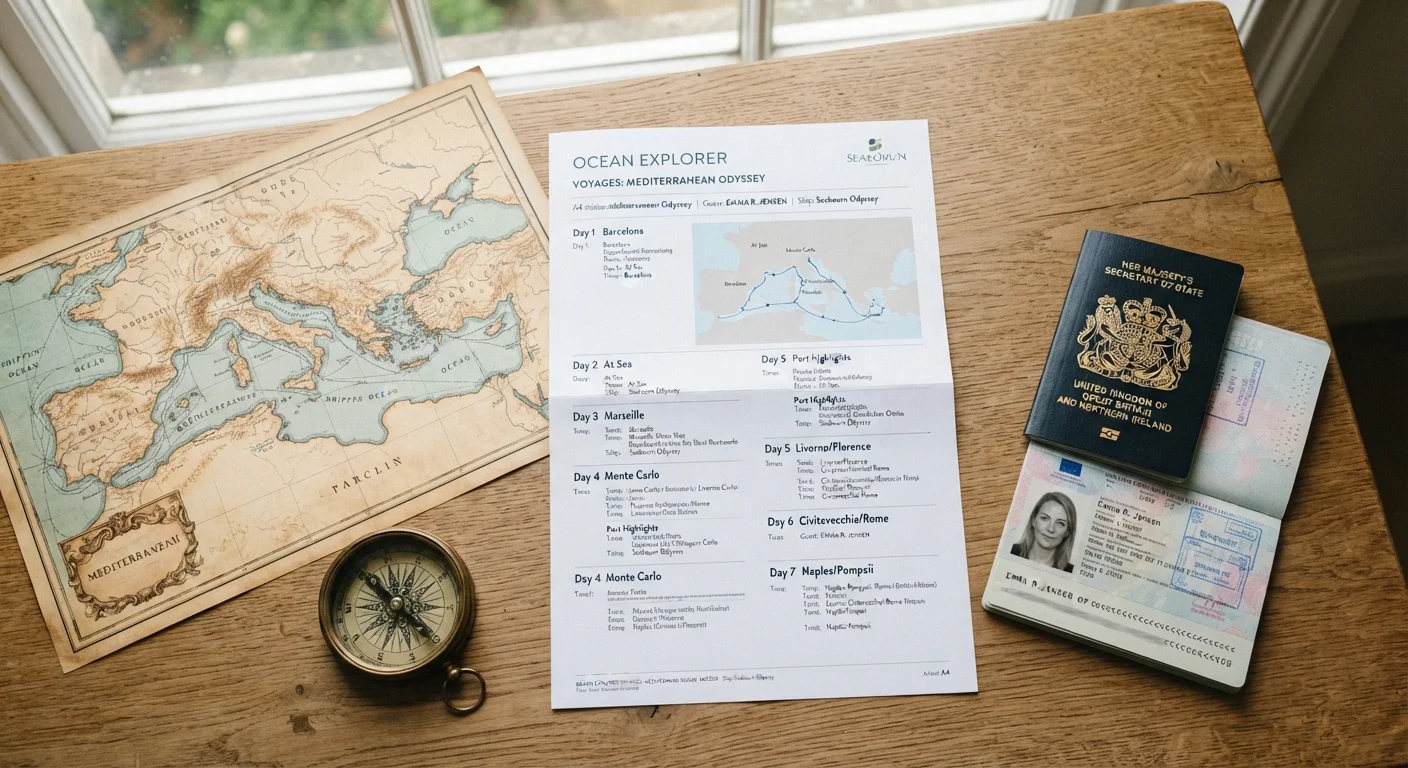
A cruise itinerary is the day-by-day schedule of a voyage, listing where the ship sails, which ports it visits, how long it stays in each location, and which days are spent entirely at sea. It tells you the sequence of destinations, the embarkation (departure) port, and the disembarkation (end) port. Lines publish itineraries months or years in advance so travelers can plan around visa requirements, excursions, and weather.
Itineraries are subject to change: cruise lines can alter or cancel port calls due to weather, mechanical issues, or local conditions. The ticket contract typically gives the line the right to substitute ports without compensation.
The basic anatomy of any cruise itinerary
A cruise itinerary has four building blocks: the embarkation port, ports of call, sea days, and the disembarkation port. Understanding each one before you compare voyages makes it easier to judge whether a particular sailing matches what you actually want from a trip.
The embarkation port is the city where you board. For US travelers, common embarkation ports include Miami, Fort Lauderdale, Galveston, New York, and Seattle, depending on the region. Getting yourself to that city on time, ideally arriving the day before the ship departs, is your responsibility. See our port-by-port walkthrough of embarkation day for what to expect once you arrive.
Ports of call are the stops along the route. Each one appears on the itinerary with a date, an arrival time, and a departure time. Those times belong to the ship. If the itinerary says the ship departs Cozumel at 5:00 PM, the ship leaves at 5:00 PM regardless of whether every passenger is back on board.
Sea days are calendar days with no port stop. The ship is in motion, and all onboard programming continues normally. A seven-night Caribbean sailing might include two or three sea days depending on the route.
The disembarkation port is the final stop. On round-trip itineraries, it is the same city as embarkation. On one-way (or "open-jaw") itineraries, the voyage ends at a different city, which requires separate travel arrangements home.
How to read the time and day information
Itineraries list times in local port time, ship time, or both, and lines are not always consistent about which they use. Before sailing, confirm with your cruise line which time zone the onboard clocks follow. Some ships keep a single time throughout the voyage; others adjust clocks as the route moves through time zones.
The window between arrival and departure in a port is not the same as your personal time ashore. After the ship docks, passengers typically wait through a clearance process before they can disembark. That can take 30 minutes to over an hour depending on the port. Subtract that time from the published window to get a realistic estimate of how long you have on the ground.
Check the ship's actual departure time
All-aboard times are typically 30 to 60 minutes before the scheduled ship departure. Look for the all-aboard notice in your booking documents or the ship's daily schedule, not just the itinerary departure time. Missing that window means missing the ship.
Overnight port stays, where the ship remains docked through the evening and sometimes a second day, appear on itineraries occasionally. These are worth noting when you compare sailings because they allow evening activities ashore that a standard day stop does not.
Itinerary types and what they tell you about the voyage
Cruise lines structure routes in a few common patterns, and knowing the pattern tells you a lot about the pace of the trip.
Loop itineraries depart and return to the same port. Most Caribbean and Alaska sailings from US home ports follow this format. You park your car or leave luggage once, and there is no one-way travel to coordinate at the end.
One-way itineraries move point to point. Mediterranean sailings often travel from Barcelona to Athens or similar pairs. These routes can cover more geographic ground, but they require flights or other travel at both ends. The Mediterranean cruise calendar covers how timing affects port availability on these routes.
Expedition itineraries operate on a different logic entirely. Rather than optimizing for the number of ports, they focus on access to remote areas, wildlife, or natural sites. Port times may be flexible and subject to conditions. The guide to expedition cruises explains how these voyages differ structurally.
Voyage length also shapes the itinerary. A three- or four-night sailing has little room for sea days and typically visits one or two ports. A fourteen-night sailing might include six or seven ports spread across a wider region, with multiple sea days between distant stops.
What an itinerary does not tell you
A published itinerary shows the schedule, not the experience of each port. Two cruises that both list Dubrovnik as a stop may deliver very different experiences depending on how long the ship stays, how many other ships are in port that day, and whether the stop is a dock or a tender (a small boat ferries passengers to shore when the ship anchors offshore). Tender ports take longer to access and have weather-dependent reliability.
Visa and entry requirements are not listed on the itinerary. If the route passes through countries that require a US passport holder to obtain a visa in advance, that responsibility falls on the traveler. Always verify current entry requirements for every country on your itinerary through the US Department of State and the consulate or embassy of each destination before booking. Requirements can change.
Accessibility at each port also varies significantly. Some stops have accessible pier facilities; others require climbing steps or navigating uneven terrain to reach the town. If mobility is a consideration for your trip, our guide to accessible cruising covers what to ask before committing to a particular route.
Pricing is separate from the itinerary structure entirely. The published schedule gives you no information about what is included in the fare. For a full picture of costs, see how cruise pricing actually works.