

| Delayed vs. lost threshold (most US carriers) | 5 to 14 days after travel (Varies by airline contract of carriage) |
| DOT domestic liability limit | Up to $3,800 per passenger (U.S. Department of Transportation) |
| International liability limit | Approx. 1,288 SDR per passenger (Montreal Convention) |
| Bag fee refund requirement | Required if bag is lost or significantly delayed (U.S. DOT enforcement guidance) |
| Property Irregularity Report (PIR) | Must be filed before leaving the airport (Standard airline procedure) |
| Claim filing deadline (international) | 21 days from when bag is returned, or declared lost (Montreal Convention, Article 31) |
How airlines classify a missing bag
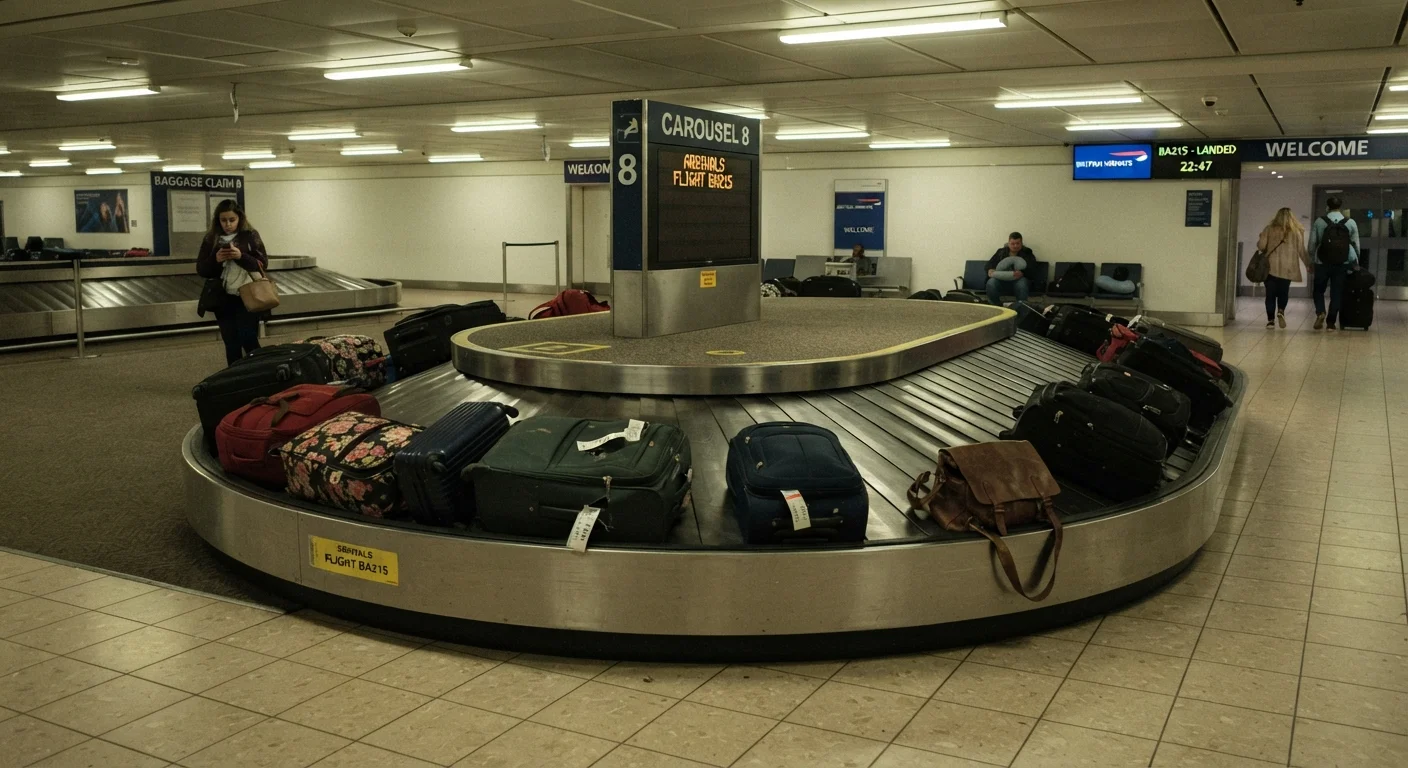
When your bag does not appear on the carousel, it is almost always classified as delayed, not lost. Airlines use that distinction deliberately: a delayed bag has no compensation clock running, while a lost bag triggers liability obligations. Most US carriers wait anywhere from 5 to 14 days before reclassifying a delayed bag as lost. The exact threshold is written into each airline's contract of carriage, which you can find on the carrier's website.
Before you leave the baggage claim area, file a Property Irregularity Report (PIR) at the airline's baggage desk. Without this report, pursuing any reimbursement later becomes significantly harder. Keep a copy of the report, your bag tag receipt, and your boarding pass.
| Delayed vs. lost threshold (most US carriers) | 5 to 14 days after travel (Varies by airline contract of carriage) |
| DOT domestic liability limit | Up to $3,800 per passenger (U.S. Department of Transportation) |
| International liability limit | Approx. 1,288 SDR per passenger (Montreal Convention) |
| Bag fee refund requirement | Required if bag is lost or significantly delayed (U.S. DOT enforcement guidance) |
| Property Irregularity Report (PIR) | Must be filed before leaving the airport (Standard airline procedure) |
| Claim filing deadline (international) | 21 days from when bag is returned, or declared lost (Montreal Convention, Article 31) |
The first 21 days: what airlines are required to do
Once you have a PIR number, the airline is required under US DOT rules to acknowledge the claim and work toward returning the bag. During this period:
- The airline must provide a status tracking number or reference so you can monitor progress.
- If your bag is delayed (not yet declared lost), many carriers offer interim expense reimbursements for essentials like clothing and toiletries. This is not a uniform federal mandate for domestic flights; policies vary by carrier. Check your airline's contract of carriage or ask an agent at the airport.
- The airline must refund your checked bag fee if the bag is significantly delayed or ultimately lost. The DOT has consistently enforced this requirement.
On international itineraries covered by the Montreal Convention, you have 21 days from the date the bag is returned (or declared lost) to submit a written claim. Missing that window can void your right to compensation, so file promptly even if negotiations are ongoing.
Travel insurance can fill gaps that airline liability rules leave open. See our overview of travel insurance coverage for how lost-luggage benefits typically work alongside airline compensation.
Property Irregularity Report (PIR)
The official form you file at the airline's baggage desk before leaving the airport. It creates a record of your missing bag and is required to pursue any compensation.
Delayed baggage
A bag the airline cannot locate immediately but expects to find and return. Airlines do not classify a bag as lost until a set number of days have passed.
Montreal Convention
An international treaty governing airline liability for delayed, damaged, or lost baggage on most international flights. It sets a maximum compensation limit measured in Special Drawing Rights (SDRs).
Special Drawing Right (SDR)
A unit of account set by the International Monetary Fund. Airlines use SDRs to express liability caps under the Montreal Convention; the dollar equivalent changes with exchange rates.
Contract of carriage
The legal agreement between you and the airline when you purchase a ticket. It spells out the airline's obligations and your rights, including how the carrier handles lost or delayed bags.
Interim expense reimbursement
Money an airline may pay toward essential purchases (clothing, toiletries) while your bag is delayed. Policies vary by carrier, and reimbursement is not uniformly guaranteed by US federal regulation.
When the bag is officially declared lost
Once an airline formally declares a bag lost, its liability cap applies. For domestic US flights, the DOT sets that cap at $3,800 per passenger. For international flights under the Montreal Convention, the cap is approximately 1,288 Special Drawing Rights per passenger (the dollar equivalent shifts with exchange rates).
These are ceilings, not automatic payouts. The airline will ask you to document the contents of the bag and their value. Receipts, purchase records, and photos help; vague descriptions often result in lower settlements. Airlines are not obligated to reimburse depreciated-value items at their original purchase price.
If you declared a higher value at check-in by purchasing excess valuation coverage from the airline, that declared amount governs instead of the standard cap. Most carriers offer this at check-in for a per-bag fee.
If you believe an airline is not meeting its obligations, you can file a complaint with the DOT's Aviation Consumer Protection Division. The DOT cannot adjudicate individual disputes, but complaint volume does factor into enforcement priorities.
For a broader look at how airline disruptions are handled, our article on how airline compensation works for bumped passengers covers a related set of passenger rights. And if your trip goes sideways for other reasons, the mid-trip cancellation recovery guide walks through steps for dealing with disruptions once you are already traveling.
International flights follow different rules
Domestic US flights fall under DOT regulations. Most international itineraries are governed by the Montreal Convention, which sets liability in SDRs rather than US dollars. If your trip crosses borders, check which treaty applies before you file a claim. Always verify current requirements with your airline and official government sources before traveling.