

Key Takeaways
- Downloading an offline translation app before departure removes dependence on local Wi-Fi or data.
- Preparing a short written card with your key needs in the local language takes minutes and pays off repeatedly.
- At a pharmacy, showing a medication package or written generic drug name is more reliable than spoken description.
- Hotels are often the most accessible starting point for resolving language issues because staff expect international guests.
- Universal gestures, numbers, and pointing remain effective when technology fails.
What you will need
Why language gaps hit hardest in three places
Most travel language moments are low-stakes: misreading a menu, mishearing a street name. But hotels, restaurants, and pharmacies are where communication failures carry real consequences. A hotel check-in error can leave you without a room. A restaurant misunderstanding can affect a traveler with a food allergy. A pharmacy exchange gone wrong can mean getting the wrong product entirely.
The good news is that each setting has predictable patterns, and a small amount of preparation handles the majority of problems you will actually face. Reading a foreign transit map covers a related challenge; this guide focuses on the face-to-face exchanges that catch travelers off guard.
Offline translation app (such as Google Translate or DeepL)
Translates spoken or typed text without requiring an active internet connection.
Screenshot or photo of hotel booking confirmation
Shows your name, reservation number, and dates without needing to explain them verbally.
Printed or saved medication card
Lists the generic name, dosage, and purpose of any medication you carry, translated into the local language.
Phrasebook app or printed phrasebook
Provides phonetic pronunciation guides for situations where showing a screen is inconvenient.
How to prepare before you arrive
Download an offline language pack for your destination before you leave home. Many translation apps let you download a specific language so the core function works without a data connection. Do this on Wi-Fi: overseas roaming costs and spotty hotel Wi-Fi make in-country downloading unreliable.
Write or save a short reference card with four to six phrases: your name, your hotel name and address, the word for your dietary restriction or allergy if relevant, and a general help phrase. The local script matters more than your pronunciation, because showing the text to a pharmacist or server is faster and more accurate than attempting to speak it.
If you carry prescription medication, check that the packaging shows the generic (non-brand) drug name. Managing a medical situation while traveling covers broader preparation for health needs abroad, including documentation worth carrying.
One preparation that covers most situations
A single note in your phone with your hotel name and address in the local script, your key allergy or dietary restriction translated, and the generic names of any medications you carry handles the majority of language-gap moments. Writing it once before departure takes about ten minutes and works whether your phone has data or not.
Step-by-step approaches for each setting
The steps below treat each venue separately because the communication goal in each is different. At a hotel, you are establishing identity and confirming logistics. At a restaurant, you are conveying preference or restriction. At a pharmacy, you are describing a physical need or an existing medication.
At the hotel: show before you speak
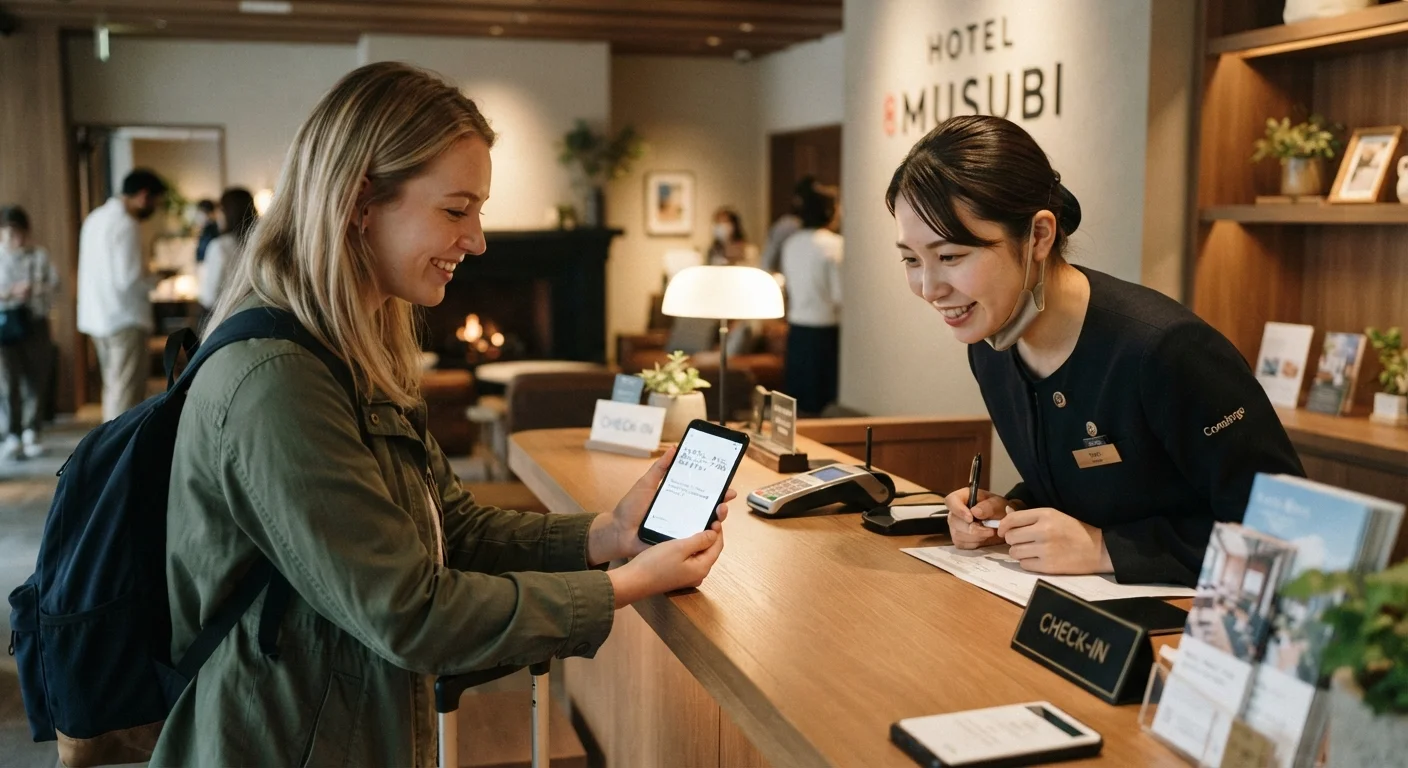
Pull up your booking confirmation on your phone before you reach the front desk. Show the screen with your name, reservation number, and dates visible. If there is a discrepancy or a question, open your translation app and type what you want to say. Many translation apps include a camera mode that can read printed text (such as a registration form) in real time.
For a room issue (temperature, a broken fixture, an extra towel), use the translation app's voice output feature. Speak your sentence in English, let the app translate it to the local language, and show or play the audio to the staff member.
At the restaurant: lead with what you cannot eat
If you have an allergy or dietary restriction, address it before ordering, not during. Show the server your written phrase card or a pre-typed translation. For a severe allergy, use the word for the allergen in the local language and the word for 'allergy' alongside it. Many translation apps let you save frequently used phrases so you are not retyping them each meal.
When ordering, point to items on the menu. If the menu has no pictures, ask the server to point to what they recommend among items you have already translated, rather than asking for a general description you may not be able to follow.
At the pharmacy: use the package or the generic name
If you need a refill or a replacement for a medication you already have, show the pharmacist the original packaging. The generic drug name printed on the label is recognized across most countries, whereas brand names differ. If you do not have the packaging, type the generic name into your translation app and show the result.
For an over-the-counter need (pain relief, antacid, antihistamine), type your symptom in your translation app and show the pharmacist. Pharmacists in most countries are trained to recommend appropriate products, and they are a faster route to resolution than attempting to find the correct aisle yourself.
Handle misunderstandings calmly and directly
When a miscommunication occurs, the fastest fix is to reset: close the conversation, take a breath, and start again with a simpler sentence or a written word. Longer, faster, or louder sentences do not help when the barrier is language rather than volume or detail.
Write the number of what you want (room number, quantity, price you understood) on paper or on your phone screen. Numbers transfer across language gaps better than almost any other form of communication. If you reach a genuine impasse, ask the person to call or find someone who speaks English rather than continuing to escalate the same exchange.
When nothing else works
If technology fails and written attempts are not resolving the issue, slow down rather than speak louder. Point, use simple hand gestures, and use numbers by holding up fingers or writing digits. Hotel staff in tourist areas frequently have a colleague with more English; asking for another staff member is a reasonable request, not an imposition.
At a pharmacy, if you cannot get what you need, write down your symptom rather than your desired product. A pharmacist can match a symptom description to a local equivalent more reliably than a brand name. For anything involving a specific prescription or a condition that could worsen without correct treatment, locate a nearby clinic or contact your travel insurance provider's assistance line before substituting a product. General guidance on locating care abroad can help you find the right contacts.
This article provides general travel communication guidance only. It is not medical advice. For health decisions, including medication needs while abroad, consult a qualified healthcare professional.